January 1, 2021
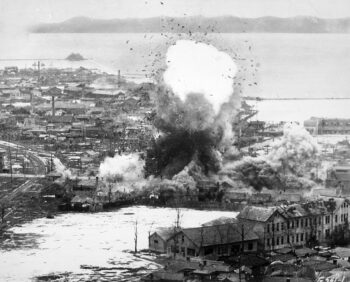
The Korean War, which broke out on June 25, 1950, can be considered the epicenter of bombing as an instrument of war. For one, it was the first—and, so far, the last—time since 1945 that the United States seriously considered using atomic weapons during the course of an imperial war. It was the first war that the United States did not win. It ended in a stalemate—an armistice—that continues until today. Kinetic fighting was suspended, but the war continues (though only by one side) by what is conveniently but simplistically called sanctions.
January 1, 2021
Gil Green was a revolutionary who became J. Edgar Hoover's "most wanted man in America" until voluntarily surrendering to authorities in February 1956. He lived a life of integrity and courage.
January 1, 2021
Ruth Milkman's latest book is a strong scholarly response to the "immigrant threat" narrative that has been central to U.S. politics in the last decades. In Immigrant Labor and the New Precariat, the distinguished labor and migration scholar has a clear goal: to reframe the conversation about migration and increased inequality in the United States, reversing the causal relation that blames migration for the U.S. working class's current perils.
January 1, 2021
The story of the Indigenous movement to stop the Dakota Access Pipeline in 2016 and 2017 has been the subject of numerous articles and documentaries, many of which depict it mainly as an environmental and climate justice campaign to stop the pipeline from crossing the Mni Sose (Missouri River), just north of the Standing Rock Sioux Reservation in North Dakota. Nick Estes and Jaskiran Dhillon's edited collection Standing with Standing Rock tells a richer and more complex story of decolonization and indigenization from the frontlines.
December 1, 2020
The United States is now in a New Cold War with Russia and China, with the focus increasingly on the latter and involving a direct challenge to U.S. hegemony over the world economy.
December 1, 2020
Fundamental to Kari Marie Norgaard's Salmon and Acorns Feed Our People is the seizure of land most evident in the overtly violent era of state-sanctioned frontier genocide and forced relocation of the Karuk. Settler colonialism, Norgaard reminds us, is an ongoing state-led project up to this day—it is not just a moment relegated to the past and, thus, the inherent treatment of Native Americans as relics of U.S. history must be challenged.
December 1, 2020
Both Toni Gilpin's The Long Deep Grudge and Michael Goldfield's The Southern Key offer ample evidence that the grand era of U.S. labor history scholarship is not yet past. The Long Deep Grudge is in equal parts labor history and family reminiscence as Gilpin seeks the fuller story of her father, who played a leadership role in the United Auto Workers union. The Southern Key is in many ways a study of a different variety, but very much of a similarly militant kind. Goldfield, a labor activist veteran himself, draws the big picture of what he sees as the central failure of the U.S. left: the failure to organize the South.
October 1, 2020
This special issue of Monthly Review, "China 2020," is the product of a long period of cooperation with critical Chinese Marxist scholars. This has resulted in an extensive series of articles on contemporary Chinese social and economic relations since 2012, to which most of the authors in the present issue have previously contributed. It takes on a special significance due to the growing conflict between the United States and China, making critical Marxist analysis in this area all the more important.
October 1, 2020
In the twenty-first century, all signs are pointing to another period of hegemonic struggle over the world economy, this time between the United States and China, although complicated in this case by the unique, indeterminate aspects of the post-revolutionary Chinese social formation, which is neither entirely capitalist nor entirely socialist.
October 1, 2020
In 2018, Washington launched the trade war against China. Measures included sharply increasing the customs tariffs borne by certain products imported from China, further barriers to imports from China, and sanctions against Chinese companies targeted by bans on the use of U.S.-made inputs. By June 2019, as tariff increases hit new sectors, China was no longer the United States's largest trading partner.