October 1, 2021
By any standards, John Burdon Sanderson Haldane (1892–1964) was a fascinating man. An eminent scientist, prolific writer and speaker, fiery political activist, and all-round colorful character, he has been the subject of several full-length biographies and multiple biographical sketches.
September 1, 2021
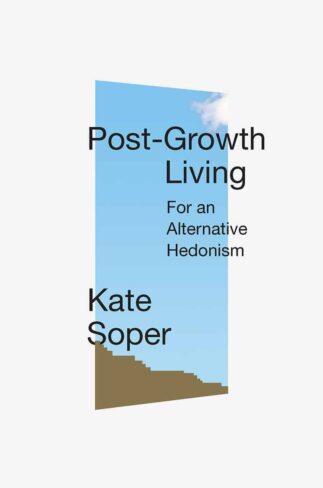
The crux of Kate Soper's Post-Growth Living is simple: we need to redefine "the good life." We need to move away from a culture that equates the good life with endless consumption and toward one that equates it with experiences that are not defined by the market. Not only is this transition ecologically necessary, but it will also lead to fairer, and far more pleasurable, experiences.
June 1, 2021
The COVID-19 pandemic is at its root a crisis of globalization, racial capitalism, colonialism, the social organization of our public health system. It is a crisis of treatment and care versus demonization and wall building. And it is the latest pandemic in a long line of modern onesÑfrom SARS to swine flu to HIV to EbolaÑa predictable and predicted outcome, not the mysterious unforeseeable lightning strike as it is often portrayed.
June 1, 2021
We who are engaged in the struggle for change might ask: "Through what lens of refraction is the evidence of events recalled and related?" If we are to resist the genocidal use of military force, and to oppose the environmental depredation that follows in its wake, we need to see the roots and laws of motion of colonialism and empire
April 1, 2021
In his Theses on Feuerbach, Karl Marx suggests that the main flaw of all previous materialism has been to uncritically accept and champion a notion of matter that has its proper place in a dualistic framework, where matter is passive and the mind is active. If this is so, true materialism will conceive of matter as an active principle, and of material beings as perfectly capable of conscious sensation and agency.
April 1, 2021
Engels was neither a reductionist nor a positivist, and, far from being a political fatalist, he embraced a form of interventionist politics that was underpinned by a historically emergent ethics. It was this standpoint that he aimed to philosophically ground in Dialectics of Nature.
April 1, 2021
Writer, editor, and prison activist Susie Day has written a beautiful, heartrending, and inspiring account of the friendship between Paul Coates and Eddie Conway. Both were born in the late 1940s and grew up in Black communities—Paul in Philadelphia and Eddie in Baltimore. Both were members of the Black Panther Party in the late 1960s and early '70s, and both were harassed by police for their radical activities as Party members. Eddie was wrongfully convicted of killing a Baltimore policeman and spent forty-four years in prison. Through it all, Paul was his steadfast friend and supporter, as well as partner in their political development and commitment to the liberation of Black people in the United States.
April 1, 2021
In Socialist Practice, a collection of essays on leftist theory and experiences, Victor Wallis adheres to the view that the achievement of socialism is a drawn out, nonlinear process consisting of episodes that in many cases have a mixed impact on the revolutionary cause. He analyzes several, ranging from the seven decades of Soviet rule to the New Left of the 1960s. His main thesis is that over the last century pure socialism has never existed and that on all fronts socialist movements and governments have contained elements of the old—namely, capitalism.
April 1, 2021
The revival of folk music—music derived from rural southern sources, unamplified, and, to a large extent, comprised of old songs of anonymous origin—was more than just another fad. Folk music encapsulated longings for an idyllic past, for a time before crass commercialism turned music into a commodity, and for relationships between musicians and audiences that were egalitarian and holistic.
March 1, 2021
A prolific political writer, Álvaro Cunhal—leader of Portugal's Communist Party for half a century and central figure of the 1974 Carnation Revolution—revealed in 1994 that he had also written several novels under the pseudonym Manuel Tiago. One of these novels, Five Days, Five Nights, was only translated into and published in English in 2020. The novella manages to capture the complexities, loneliness, and bravery of ordinary people, highlighting how we are the ones who keep us safe.