

History comes in bad cycles
- Issue:
- Vol. 72, No. 11 (April 2021)
April 1, 2021
A new poem by Marge Piercy.
April 1, 2021
A new poem by Marge Piercy.

April 1, 2021
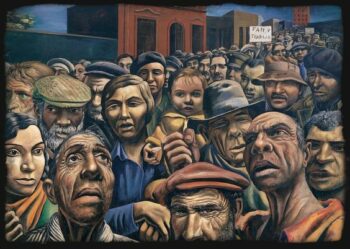
Writer, editor, and prison activist Susie Day has written a beautiful, heartrending, and inspiring account of the friendship between Paul Coates and Eddie Conway. Both were born in the late 1940s and grew up in Black communities—Paul in Philadelphia and Eddie in Baltimore. Both were members of the Black Panther Party in the late 1960s and early '70s, and both were harassed by police for their radical activities as Party members. Eddie was wrongfully convicted of killing a Baltimore policeman and spent forty-four years in prison. Through it all, Paul was his steadfast friend and supporter, as well as partner in their political development and commitment to the liberation of Black people in the United States.

April 1, 2021
The revival of folk music—music derived from rural southern sources, unamplified, and, to a large extent, comprised of old songs of anonymous origin—was more than just another fad. Folk music encapsulated longings for an idyllic past, for a time before crass commercialism turned music into a commodity, and for relationships between musicians and audiences that were egalitarian and holistic.

February 1, 2021
On California's November 2020 ballot were some contentious and important issues, including Proposition 22, classifying rideshare drivers and app-based delivery workers as independent contractors. Gig economy giants Uber, Lyft, Doordash, and others spent a whopping $111 million on Prop 22. Of course, the companies had a lot to lose. If they were made to treat their drivers or delivery people as employees and compensate them accordingly, they would be bankrupted, they claimed.

February 1, 2021
The Ecological Revolution was first published a little more than ten years ago in April 2009, at a time when climate change had already been recognized as a pressing global issue for over two decades, but when there was still hardly any realistic discussion of its connection to capitalism or of the immense ecological and social revolution that would be required to overcome the Earth System crisis. Let us look back to understand the historical gulf separating that time from our own.

February 1, 2021
It is a testament to the clarity and scope of Mark Jay and Philip Conklin's vision that A People's History of Detroit is replete with insights for those trying to make sense of these deeply uncertain and troubling times. In it, Jay and Conklin show that "in order to give a true 'people's history,' one must do more than condemn the malevolence of those in power and celebrate the activists who have struggled for justice; one must also come to terms with the social system in which these people lived. In our case, this means confronting the logic of capital."

January 1, 2021
We are extremely pleased to announce that John Bellamy Foster, editor of Monthly Review, has won the prestigious Deutscher Memorial Prize for 2020 for his The Return of Nature: Socialism and Ecology.
January 1, 2021
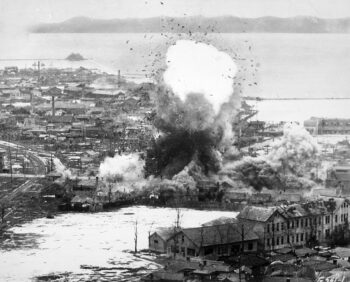
The Korean War, which broke out on June 25, 1950, can be considered the epicenter of bombing as an instrument of war. For one, it was the first—and, so far, the last—time since 1945 that the United States seriously considered using atomic weapons during the course of an imperial war. It was the first war that the United States did not win. It ended in a stalemate—an armistice—that continues until today. Kinetic fighting was suspended, but the war continues (though only by one side) by what is conveniently but simplistically called sanctions.

January 1, 2021
Gil Green was a revolutionary who became J. Edgar Hoover's "most wanted man in America" until voluntarily surrendering to authorities in February 1956. He lived a life of integrity and courage.