April 1, 2026
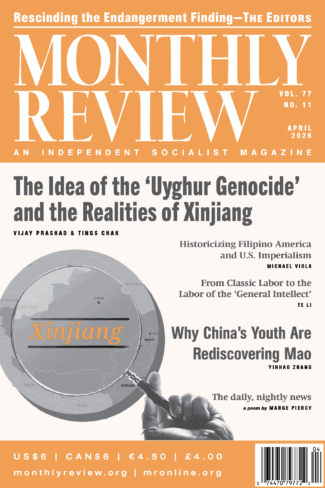
While the "world is rapidly approaching tipping points that spell irreversible and catastrophic climate change," write The Editors, "we are not seeing the necessary turn from ecological reform to ecological revolution, but rather the rise of ecological reaction.… An absolute no-quarters war from above is now being waged against all political attempts to address climate change." This attack is epitomized by "the Donald Trump administration's goal of removing the 2009 Endangerment Finding of the Clean Air Act that underlies all national climate legislation in the United States." While this tactic is unlikely to succeed, the proliferation of similar attacks clearly demonstrate that "[m]onopoly-finance capital has now abandoned the energy transition, which was its only answer to climate change."
April 1, 2026
What is really happening in Xinjiang? Vijay Prashad and Tings Chak write: "There is no evidence of a policy of physical annihilation of the Uyghur peoples by the Chinese government, unlike say, direct evidence of extermination by the Israeli government against the occupied Palestinian people. There are no mass graves and no accusations of systematic killing—the hallmarks of a genocide."
April 1, 2026
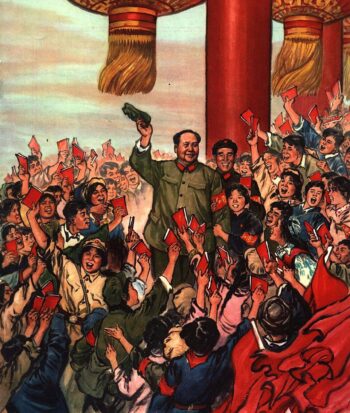
Yinhao Zhang explains the aspects of contemporary Chinese society contributing to the resurgent interest in Mao Zedong among China's youth. Mao, Zhang writes, is capturing the interest of a generation dissatisfied with the entrenched power structures and class privilege accompanying the neoliberalization of markets over recent decades. Indeed, these youth are revisiting the very roots of the Chinese Revolution, signaling a yearning for a radical political future.
April 1, 2026
Michael Viola explores the building of the Filipino identity in the context of U.S. imperialism. The broad-reaching effects of this "deadliest phase of imperialism," combined with pervasive anti-Asian racism in the United States, fuels the idea of a collective political project that "comes with the praxis, the power, and the price of a unique lineage" extending across an ocean and intimately connected to the dark history of U.S. militarism abroad.
April 1, 2026
Applying Marxist labor theory to the rise of artificial intelligence and its effects on workers, Te Li presents an understanding of labor in the age of increasing reliance on algorithms and digital technologies. As Li argues: "In the civilization of general intellect labor, where the knowledge economy dominates, knowledge-intensive labor such as scientific research, technological innovation, artistic creation, and education and training will become primary forms of labor."