December 1, 2025
In this reprint of a
Seattle Weekly article from 2004, Knute Berger details a game of Monopoly played among friends, including Robert W. McChesney and John Bellamy Foster, while students at The Evergreen College. With sly insight, Berger shows how Foster and McChesney's antics as board game robber barons revealed McChesney's perceptive analysis of the media landscape under capitalism and his passionate advocacy for democratic, monopoly-free media.
December 1, 2025
To conclude our special issue on Robert W. McChesney's legacy,
MR presents a series of tributes capturing his impact on the world around him. The diversity represented by these illustrious contributors, from his colleagues at the media watch group Fairness and Accuracy in Reporting (FAIR) to Senator Bernie Sanders, is a testament to McChesney's enduring influence.
November 1, 2025
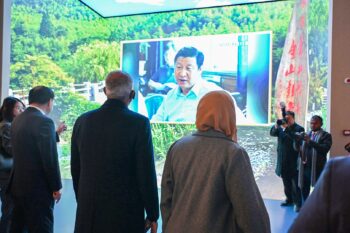
Helena Sheehan reflects on the evolution of her intellectual political relationship to China, a journey that began with limited knowledge of a seemingly far-away land and ends with a nuanced understanding grounded in her on-the-ground experiences as a visiting professor at Peking University. Through political and cultural analysis, Sheehan gives readers a peek into what how the Chinese Revolution continues to unfold.
November 1, 2025
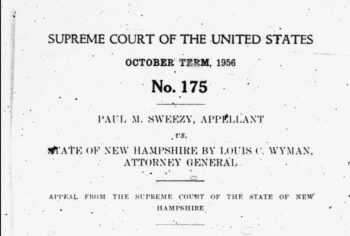
In this reprise from April 2000, John J. Simon explored the consequences of the landmark Supreme Court case
Sweezy v. New Hampshire, which saw
MR founding editor facing off against the state of New Hampshire after refusing to respond to questions concerning his political activities. While the case is often seen as marking the waning of McCarthyism,
MR editors had a different view: the decline was due to the successful ascension of capitalist interests in U.S. society. "The extreme right had served its purpose, Simon noted, "and could now be reined in."
October 1, 2025
"Why," Helena Sheehan asks, "have Marxists…put so much emphasis on the history of philosophy?" She adds: "Is the current G. W. F. Hegel revival conductive to coming to terms with the current conjuncture?" In answering these questions, Sheehan elucidates deep truths about the core of Marxist philosophy and practice, and the importance of remaining deeply rooted in the real world.
September 1, 2025
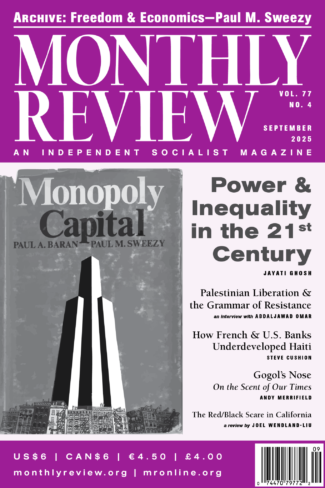
In order to understand the crisis of the imperialist world system in the twenty-first century,"
MR editors write in this month's "Notes from the Editors," "it is crucial to see this in terms of the
present as history, that is, as an outgrowth of a centuries-long historical process." Following this thread from the long sixteenth century through to the present day, the editors dissect the material conditions leading the emergence to a new and decidedly anti-imperialist revolutionary subject.
July 1, 2025
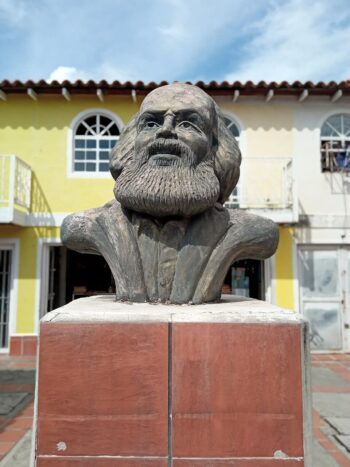
In this innovative study, John Bellamy Foster gets to the heart of Marx's writing on communal societies—an aspect of Marx's work that is often overlooked, despite its importance to the socialist project. Tying together Marx's studies of anthropology, history, and ethnology, Foster illuminates the centrality of communalism to Marx's overall critique of class-based societies.
July 1, 2025
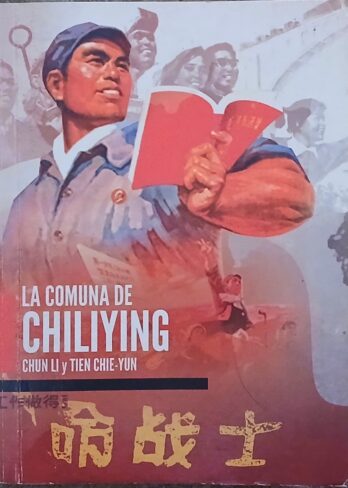
Inside a People's Commune is a short 1974 book documenting life in the Chiliying Commune, one of the earliest in revolutionary China. The text explores the commune's organization, challenges, achievements, and mass-based character. Hugo Chávez later drew inspiration from the book, citing it when launching Venezuela's communal project. Today, it continues to serve as a pedagogical tool for Venezuelan communards working to build a unified system of socialist self-government.
June 1, 2025
This month, the editors dive into the history of Nazi Germany for a discussion of
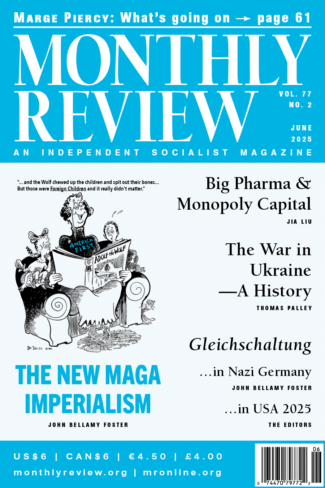
Gleichschaltung, which in this instance describes the "falling into line" of institutions and individuals under fascism. As the editors point out, the extralegal and norm-breaking actions may be justified rhetorically by the fascist regime but require the acquiescence of the larger society in order to become effective—a process we are currently watching in real time.
June 1, 2025
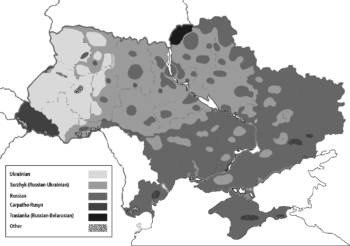
Thomas Palley identifies and illuminates both the internal and external drivers of the war in Ukraine. Through this article, he explores how the breakup of the Soviet Union, the aggressive expansion of NATO, U.S. neoconservative geopolitics, present-day Ukraine's domestic tensions, and other factors led to the current conflict, in which the only winner seems to be the United States.