September 1, 2020
Any serious treatment of the renewal of socialism today must begin with capitalism’s creative destruction of the bases of all social existence. Since the late 1980s, the world has been engulfed in an epoch of catastrophe capitalism, manifested today in the convergence of (1) the planetary ecological crisis, (2) the global epidemiological crisis, and (3) the unending world economic crisis. Added to this are the main features of today’s “empire of chaos,” including the extreme system of imperialist exploitation unleashed by global commodity chains; the demise of the relatively stable liberal-democratic state with the rise of neoliberalism and neofascism; and the emergence of a new age of global hegemonic instability accompanied by increased dangers of unlimited war.
September 1, 2020
Among ethnic disasters of the past few decades, few can match in intensity or have been reported in the media more extensively than those of the Indigenous in Guatemala. The social structure of the nationÑits hierarchy, driven by a light-skinned population, most of whom are ethnically mestizo but who do not identify with the purely IndigenousÑits history, and its small size make it an important site for the documentation and reporting of ethnic disputes and differences.
September 1, 2020
A new poem by Marge Piercy.
July 1, 2020
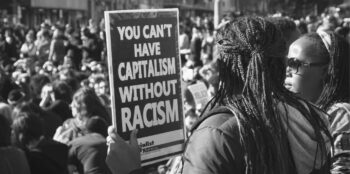
The entire United States has been upended by weeks of protests, extending to over 150 cities, sparked by the racist police murder of George Floyd. The present special issue of Monthly Review is devoted to exploring the complex interweaving of the classical Marxian critique with the rapidly developing critique of racial capitalism.
July 1, 2020
In recent years, "racial capitalism" has ascended across the humanities and social sciences. It has arisen as a conceptual framework to understand the mutually constitutive nature of racialization and capitalist exploitation, inter alia, on a global scale, in specific localities, in discrete historical moments, in the entrenchment of the carceral state, and in the era of neoliberalization and permanent war.
July 1, 2020
Oliver Cromwell Cox insisted on dealing with the crucial issues of his time and on telling the truth as he saw it, regardless of whose toes may have been stepped on or whose sensibilities may have been injured. He has aided in preventing the complete stultification of academic social science and in the long run exercised an immense influence on American life.
July 1, 2020
The rise to prominence of analyses of racial capitalism represents a breakthrough in Marxian theory. This has necessarily been accompanied by a critique of previous Marxian analyses, which all too often ignored or minimized the relation of slavery to capitalism. In recent years, however, these criticisms of orthodox Marxist treatments of slavery have been extended, much more problematically, to the work of Karl Marx himself. Although Marx never wrote a treatise on slavery, the issue of slave labor was woven into his analysis of social formations, both ancient and modern, and was inextricably intertwined with his treatment of wage labor.
June 1, 2020
Overcoming the HIV/AIDS and Special Period crises prepared Cuba for COVID-19. Aware of the intensity of the pandemic, Cuba knew that it had two inseparable responsibilities: to take care of its own with a comprehensive program and to share its capabilities internationally.
June 1, 2020
Three decades after liberal democracy replaced the military dictatorship of 1964–85, the far right in Brazil has made a comeback, most starkly with the electoral victory of Jair Bolsonaro in 2018. Bolsonaro, however, is not an isolated individual; rather, his government is characterized by an authoritarian style of neoliberalism built on a series of alliances, a prominent one of which is with the judiciary. This coalition boasts connections with the military and police forces, the evangelical religious right, and agribusiness.
June 1, 2020
In 2021, Angela Merkel's fourth and last term as the chancellor of Germany will end. To understand Merkel's domestic and foreign policy, one must understand the country she inherited. She came to power in 2005 following the first center-left government since 1982, the government of Gerhard Schröder, and was in the fortunate position of becoming chancellor after a coalition government of social democrats and Greens had done the devil's bidding of implementing very unpopular neoliberal policies to the sole benefit of German capital and the rich.