February 1, 2020
Mike Gonzalez's new biography of JosŽ Carlos Mari‡tegui is an important attempt to introduce the Peruvian socialist to an English-speaking audience. It constitutes not so much a rediscovery of Mari‡tegui, but is itself part of a slow but steady embrace of a novel and innovative thinker broadly credited with the creation of a Latin American Marxism.
January 1, 2020
The coup against the Bolivian government under Evo Morales came straight out of the latest political-military manuals of the U.S. imperial state. These manuals provide instructions on how systematically to undermine the reputation of a popular, elected leader with accusations of dictatorship, corruption, and various other forms of character assassination in order to soften support on the left. Moreover, these manuals provide step-by-step instructions on how to prepare the political and military bases of a coup.
January 1, 2020
In The Mexican Revolution in Chicago: Immigration Politics from the Early Twentieth Century to the Cold War, John H. Flores illustrates the growth of the Mexican population in 1920s Chicago and how migrant communities situated and organized themselves politically in an often-hostile social environment. Drawing from political experiences in Mexico, Flores identifies and explores the evolution of a Mexican population whose identities and loyalties were shaped and divided by the Mexican revolutionary and counterrevolutionary processes in la patria (the homeland).
November 1, 2019
We are seeing today what appear to be the beginnings of an ecological revolution, a new historical moment unlike any humanity has experienced. Not only is the planet burning, but a revolutionary climate movement is rising up and is now on fire in response.
November 1, 2019
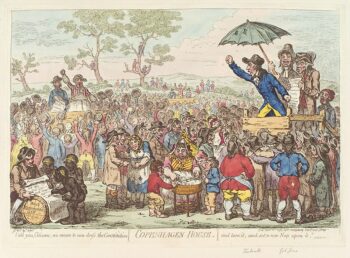
November 5, 2019, is the 225th anniversary of the acquittal of Thomas Hardy on charges of High Treason. Hardy is nearly forgotten today, but for decades workers and democrats in England celebrated November 5 as the anniversary of a major victory, a triumph over a powerful state that had deployed immense resources to crush working-class organizations and suppress popular demands for democratic rights.
October 1, 2019
In an interview with Farooque Chowdhury, Monthly Review editor John Bellamy Foster speaks about the historical conditions associated with the rise of new far-right movements of a broadly neofascist character. What we are witnessing, especially in the advanced capitalist world, is the development of a neoliberal-neofascist alliance, reflecting the decline of the liberal-democratic state. Neofascism is the most dangerous and volatile phenomenon in this emerging right-wing historical bloc. All of this has to be seen in relation to the structural crisis of capitalism and growing ruling-class attempts to restructure the state-capital relationship so as to create regimes more exclusively for capital.
October 1, 2019
Costas Lapavitsas's The Left Case Against the EU (Polity, 2019) is recognized as the leading work advocating Lexit, the left-wing case for Brexit, and for nations leaving the European Union more generally. In light of current Conservative British Prime Minister Boris Johnson's commitment to exit the European Union by October 31, even if it means a no-deal Brexit, the role of the left takes on growing importance. Moreover, this raises issues of the European Union generally, including the dominance of neoliberalism within it and the question of German hegemony. Here, Neil Davidson offers an assessment of Lapavitsas's book.
October 1, 2019
In this continuation of the exchange on the European Union, the United Kingdom, and the left, Andy Storey engages with Costas Lapavitsas's arguments in The Left Case Against the EU.
October 1, 2019
As part of the exchange on the European Union, the United Kingdom, and the left, Costas Lapavitsas provides an extensive response to Neil Davidson's and Andy Storey's contributions.
October 1, 2019
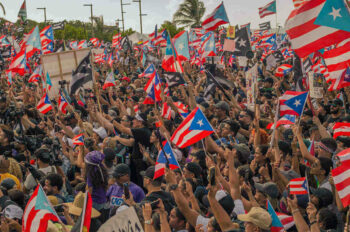
Naomi Klein's The Battle for Paradise (Haymarket, 2018) describes a duel of dreams for post-Hurricane Mar’a Puerto Rico. On the one hand, networks of resistance and resilience sprang up around the island in the wake of the collapse of not just trees and houses, but infrastructure and government. On the other, a small group of super rich speculators and futurists were poised to cash in on what Puerto Rico's then-Governor Ricardo Rossell—ó described as an opportunity to "sort of restart and upgrade" a nation he shamelessly called a "blank canvas." Rossell—ó— was forced out of office on July 24, 2019, by mass protests, in large part thanks to the networks of resistance and resilience that came to life when the government essentially disappeared after the 2017 hurricanes.