July 1, 2026
In order to comprehend the environmental crisis that goes hand-in-hand with the "Structural Crisis of Capital," we must also understand the nature of global value chains and how they contribute to environmental degradation and worker exploitation on a global level. Benjamin Selwyn elucidates how global value chains and digitalization sit within a "conjoined dynamic of labor-exploitative accumulation and ecological expropriation."
March 1, 2026
Karl Marx originally planned to complement
Capital with an additional work exploring capitalism from the side of the workers, which he never completed. In this article, Chris Gilbert argues that this projected "workers' side of Marxism" has a special relevance to the processes of anti-imperialist struggle in the Global South, explaining why they often turn to socialism despite underdeveloped productive forces and the relative scarcity of a classical proletariat.
January 1, 2026
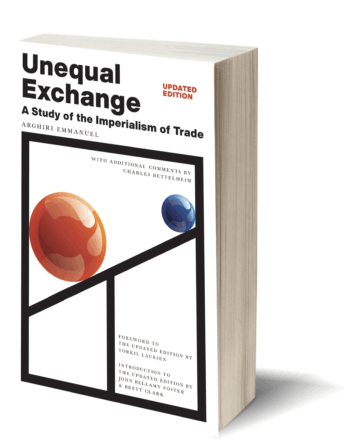
In this Introduction to the updated edition of
Unequal Exchange by Arghiri Emmanuel, published by Monthly Review Press, John Bellamy Foster and Brett Clark offer readers insight into the continuing influence of Emmanuel's seminal work. Through both deep understanding thoughtful critique, the authors deftly situate Emmanuel's text as an indispensable part of an enduring tradition of Marxist analysis of the global dynamics of labor.
October 1, 2024
Steve Ellner deconstructs the argument that Pink Tide governments elected since 2018 are in a state of "passive revolution," having betrayed their progressive roots through concessions to conservative elements and capital. This analysis, Ellner finds, fails to capture the material impacts of Pink Tide governments, their strategic importance, or their potential to pull societies toward a more radical leftist future.
May 1, 2024
The International Monetary Fund, part of the Bretton Woods Agreement that helped establish the current rules of the U.S.-dominated international capitalist system, claims to aim for a world of prosperity through so-called free trade. In Latin America, David Barkin and Juan Santarcángelo write, the IMF has contributed to the impoverishment of the working class and destruction of these countries' ecological legacies. But what does the future hold for the IMF in Latin America?
January 1, 2024
Oscar Feo Istúriz reviews Social Medicine and the Coming Transformation, an extensive work that explores the concept of collective health, from its early basis in classical Marxism to its contemporary implementation in Latin America (and lack thereof in the United States). This model of social medicine-collective health has the potential to not only replace the dysfunctional model of public health under capitalism, but open up new pathways toward profound social transformation.
April 1, 2023
Andy Higginbottom analyzes the influence of Ruy Mauro Marini on dependency theory and the concept of superexploitation. Marini, he explains, carried Marx's legacy forward—but there is still work to be done in the twenty-first century.
March 1, 2023
Steve Ellner analyzes the debate surrounding the wave of elections of left-leaning political leaders in Latin America, known as the Pink Tide. Critics of these governments, Ellner suggests, emphasize their shortcomings at the expense of recognizing their anti-imperial position.
November 1, 2020
In his book Chicano Communists and the Struggle for Social Justice, Enrique M. Buelna examines the life of Ralph Cuarón, a Mexican-American or Chicano seaman, furniture maker, father, husband, and lifelong activist who joined the Communist Party at age 19 during the Second World War. The Communist Party, however, largely ignored Mexican workers and local members were not pleased with his organizing of that segment of the working class. In the early twenty-first century, the Mexican question remained, although it became known as the "Latino question" after considerable immigration from Central America in the 1980s and '90s. In their book The Latino Question: Politics, Labouring Classes, and the Next Left, Armando Ibarra, Alfredo Carlos, and Rodolfo D. Torres deconstruct the word Latino, arguing that it homogenizes an extremely diverse population.
February 1, 2020
Mike Gonzalez's new biography of JosŽ Carlos Mari‡tegui is an important attempt to introduce the Peruvian socialist to an English-speaking audience. It constitutes not so much a rediscovery of Mari‡tegui, but is itself part of a slow but steady embrace of a novel and innovative thinker broadly credited with the creation of a Latin American Marxism.