July 1, 2025
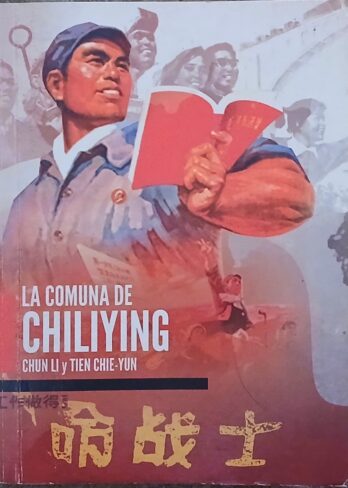
Inside a People's Commune is a short 1974 book documenting life in the Chiliying Commune, one of the earliest in revolutionary China. The text explores the commune's organization, challenges, achievements, and mass-based character. Hugo Chávez later drew inspiration from the book, citing it when launching Venezuela's communal project. Today, it continues to serve as a pedagogical tool for Venezuelan communards working to build a unified system of socialist self-government.
June 1, 2025
A new poem by Marge Piercy.
April 1, 2025
What is ecological civilization? In this article, Chen Yiwen presents a dialectical analysis that illuminates the theoretical and practical elements of ecological civilization, particularly as it develops in the context of China. In China, she notes, significant progress has been made, but there remain outstanding questions that must be resolved during the transition to an ecologically harmonious society that promotes global equality and human flourishing.
March 1, 2025
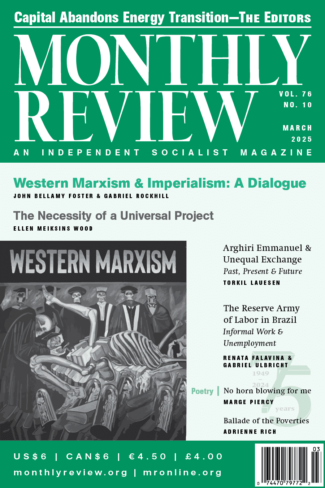
The editors analyze recent shift in mainstream discourse away from the goal of energy transition toward capitalist friendly policies that allow corporations to receive large subsidies for inadequate "solutions." Despite the scientific consensus that these are insufficient to tackle the planetary crisis, capital and its advocates continue to promote the abandonment of the energy transition in the effort to maintain U.S. imperial dominance and feed its hunger for fossil fuels.
February 1, 2025
Since the 1980s, writes Lu Xinyu, a division between industrial and agricultural labor has grown in China, reflected in the fractured relationship between urban and rural areas. China's successful navigation of the issue, Lu concludes, relies on creating a vigorous alliance between the rural peasantry and urban workers that aids in the ultimate delinking of China from the imperialist, world system. Chinese-style modernization, Lu concludes, represents a path that, while developed in a Chinese context, "represents the aspirations of the Global South to break free from worldwide Western hegemony."
February 1, 2025
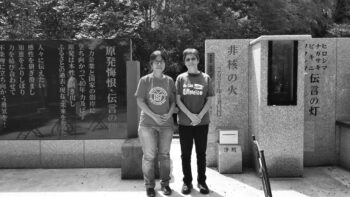
In this deeply stirring account, Sit Tsui and Lau Kin Chi share their field research, conducted over years of travel and relationship-building, into the Japanese antinuclear movement. As the people and environment of Fukushima continue to be impacted by the disaster at the Fukushima Daiichi power plant in March 2011, the No-Nukes movement has grown in response, encompassing aspects of society ranging from artists and monks to fisherfolk and intellectuals.
January 1, 2025
In January's Review of the Month, John Bellamy Foster and Brett Clark revisit the legacy of scientist and
MR author Richard Levins, from his "red diaper" infancy to his agroecological work in Cuba and his contributions to Marxian ecological thinking as a whole. "As a dialectical ecologist," they write, "Levins proposed that we ask the big questions, as part of understanding why the world came to be organized in a particular way, and how it might be different."
January 1, 2025
In this interview with Claudia Antunes of Brazilian magazine Sumaúma, Ian Angus takes stock of our current planetary crisis, from its origins in Marx's ecological thought and the present debate over its designation to the future of human civilization as we know it. "The key question is," he concludes, "Are we going to see large number of people moving for change?"
January 1, 2025
In this talk given at Peking University in October 2024, John Bellamy Foster shares ten theses describing both the roots and contemporary manifestations of the idea of ecological civilization. Relating the concept's origins in the writings of Marx and Engels to its expression today in Chinese society, Foster reveals the inherently socialist nature of eco-civilization and the necessity of a worldwide ecological revolution to shift toward sustainable human development.
December 1, 2024
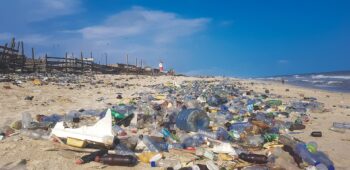
Following Harry Braverman's assertion that we must examine "by way of concrete historical specific analysis of technology…on one side and social relations on the other" in order to understand the impact of the Scientific-Technical Revolution on our daily lives, John Hedlund and Stefano B. Longo describe the explosion of the Synthetic Age of plastics, revealing the commodification of science in service of capital.