March 1, 2023
March's "Notes from the Editors" revisits the Non-Aligned Movement and its growing role in the New Cold War. The rise of Russia, China, BRICS, and other nonaligned countries hearlds the emergence of a new, multipolar world, counteracting the global hegemony of the United States.
February 1, 2023
Tomás Mac Sheoin reviews Road to Repeal, which documents the struggle for abortion rights in Ireland, from its constitutional prohibition to the ban's repeal in 2018.
December 1, 2022
This month's "Notes from the Editors" takes on the Biden Administration's recently released National Security Strategy, a bellicose document that rattles sabers towards the supposed autocracies of Russia and China while reviving the age-old lie of the United States as protector of democracy.
December 1, 2022
Arianto Sangadji traces the relationship between the state and mining capital in Indonesia throughout the historical capitalist development of the country from Dutch colonialism to the contemporary practices of multinational mining corporations. While these powerful firms have generated significant profits, they are also associated with dispossession, environmental degradation, and ruthless labor exploitation, spurring resistance from the local populations.
November 1, 2022
Two years after the peak of the 2020 street protests for reproductive rights in Poland, Magdalena Muszel and Grzegorz Piotrowski explore the movement's effects on Polish society. Despite the dissipating energy of the participants and continued intransigence of most major parties, this cycle of protests shifted the values and political preferences of specific gender and age groups, as well as affecting the common perception of protest movements in Poland.
November 1, 2022
In this reprint of the February 1994 "Notes from the Editors," former MR editors Harry Magdoff and Paul M. Sweezy ask: "The United States could not have won a more decisive victory in the Cold War. Why, then, does it continue to act as though the Cold War is still on?"
October 1, 2022
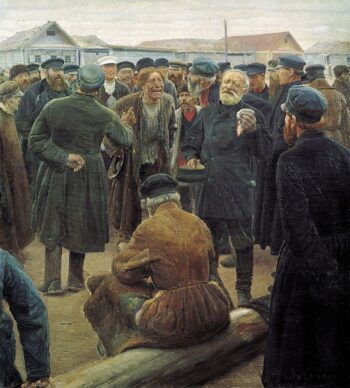
In the past and in his own time, Marx has been portrayed as endorsing the enclosure of the commons as a necessary historical stage on the path to socialism. However, a more accurate account, one that is critical of the enclosure movement, can be found in his response to the destruction of commons-based peasant communities in Russia—while it was actually happening.
October 1, 2022
The Soviet Union's efforts at centralized economic planning suffered greatly by neglecting to integrate cybernetics into a comprehensive model. Today, this cybernetic approach to economic planning is still blocked. The time has come to implement alternative planning in the form of an automated model that coordinates the activities of all industries and sectors of toward a prosperous and sustainable future.
September 1, 2022
Our current geological time period, characterized by drastic planetary shifts due to anthropogenic climate change, is popularly known as the Anthropocene Epoch. Recent proposals for naming the first age of this epoch highlight capitalism's central role in the ongoing climate crisis.
September 1, 2022
Recent scholarship suggests that the widespread perception of Soviet states as uniquely ecologically disastrous is, at best, exaggerated, and that these environmental legacies must be re-examined.