October 1, 2025
Oscar R. Ralda reviews Vanessa Christina Wills's
Marx's Ethical Vision (2024). Wills's text, Ralda notes, demonstrates a "facility with which [she] deals with Marx's works, as well as a "strong philosophical case…for the ongoing relevance of a coherent Marxian moral theory." The latter, Rada notes, sheds light on the moral imperative to work toward socialist liberation from a foundation of resolute Marxian values.
September 1, 2025
In order to understand the crisis of the imperialist world system in the twenty-first century,"
MR editors write in this month's "Notes from the Editors," "it is crucial to see this in terms of the
present as history, that is, as an outgrowth of a centuries-long historical process." Following this thread from the long sixteenth century through to the present day, the editors dissect the material conditions leading the emergence to a new and decidedly anti-imperialist revolutionary subject.
September 1, 2025
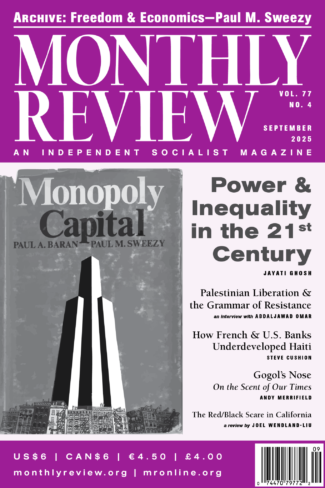
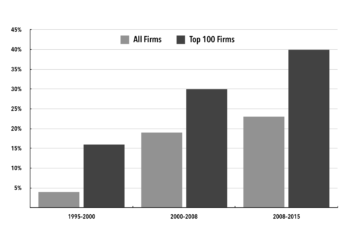
Jayati Ghosh illuminates how capitalism has exacerbated inequality not only due to market forces, but as a result of how wealthy countries and firms based within them have tilted the scales toward themselves, disenfranchising the rest of the world in the process. This pervasive economic inequality, Ghosh concludes, undermines the idea and practice of true democracy.
September 1, 2025
"Assume a ship under the command of a mad captain headed for certain shipwreck. What would freedom mean to the people on board?" asked
MR cofounder Paul M. Sweezy in this previously unpublished discussion piece. "There can hardly be any doubt about the answer…the essence of freedom for the people on the ship is the ability to control their
collective fate."
July 1, 2025
This month's "Notes from the Editors" discusses the accelerating progress of China toward sustainability. China's decline in carbon emissions and rapidly decarbonizing energy sector demonstrates the importance of societal realignment and extensive planning to shift toward the ecological modernization that has continued to elude monopoly-capitalist regimes.
July 1, 2025
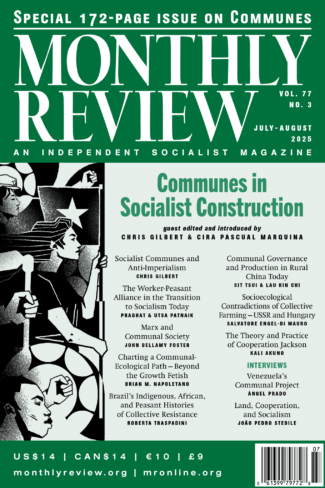
Inspired by the Venezuelan project of building socialism via the commune, this special issue looks at attempts to use communal models in socialist projects in a range of different contexts, as well as the theoretical bases for such an endeavor. In their introduction, guest editors Chris Gilbert and Cira Pascual argue that the theme of
Communes in Socialist Construction is an important opportunity for engaged Marxist reflection of a kind that offers valuable contributions to the universal body of socialist thought.
July 1, 2025
Chris Gilbert proposes to answer the question: When is a socialist commune anti-imperialist? His response follows Karl Marx's line of thought, looking at the latter's approach to the commune from the
Grundrisse through his late notes and letters on rural communes. After reconstructing the Marxist communal strategy, Gilbert argues that real-world projects in Venezuela, Bolivia, and Brazil in recent times conform to this overall Marxist approach, combining communal construction with an anti-imperialist drive for national liberation.
July 1, 2025
Prabhat and Utsa Patnaik consider the historical views of the relationship between the proletariat and peasantry during the revolutionary transition to socialism and struggle against imperialism. While other thinkers have suggested that alliances between the two groups must be shed in order to complete the revolution, the Patnaiks propose a framework of voluntary cooperatization benefiting all.
July 1, 2025
In this innovative study, John Bellamy Foster gets to the heart of Marx's writing on communal societies—an aspect of Marx's work that is often overlooked, despite its importance to the socialist project. Tying together Marx's studies of anthropology, history, and ethnology, Foster illuminates the centrality of communalism to Marx's overall critique of class-based societies.
July 1, 2025
Brian M. Napoletano revisits the concept of generalized autogestion, traditionally defined broadly as "self-management," placing it in the context of an ecological path to socialism. Using this orientation, Napoletano leads to reader to consider the potential of socioecological approaches to repairing the metabolic rift and pursuing sustainable human development.