November 1, 2022
In this reprint of the February 1994 "Notes from the Editors," former MR editors Harry Magdoff and Paul M. Sweezy ask: "The United States could not have won a more decisive victory in the Cold War. Why, then, does it continue to act as though the Cold War is still on?"
October 1, 2022
This year is the fiftieth anniversary of The Limits of Growth, one of the most influential, and also controversial, environmental studies ever written. No other environmental work of the 1970s offered such a direct challenge to the underlying assumptions of capitalist neoclassical growth economics, or was responded to so vehemently by establishment thinkers.
October 1, 2022
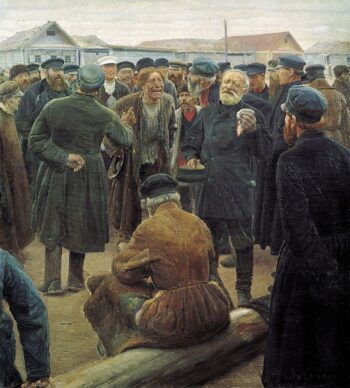
In the past and in his own time, Marx has been portrayed as endorsing the enclosure of the commons as a necessary historical stage on the path to socialism. However, a more accurate account, one that is critical of the enclosure movement, can be found in his response to the destruction of commons-based peasant communities in Russia—while it was actually happening.
October 1, 2022
Monthly Review was started in 1949 and is now in its forty-fourth year of publication, so you could say that MR's existence is pretty much coterminous with the second half of the twentieth century. What have been the most important characteristics of this half century?
September 1, 2022
Recent scholarship suggests that the widespread perception of Soviet states as uniquely ecologically disastrous is, at best, exaggerated, and that these environmental legacies must be re-examined.
July 1, 2022
Between 1949 and 1980, over a hundred articles in Monthly Review dealt with the Soviet Union directly, with many more addressing it indirectly. But, after 1993, treatments of post-Soviet Russia in the magazine largely ceased.
July 1, 2022
Contradicting previous liberal notions of an "end of history," humanity is now facing unprecedented threats to our species' survival, but an environmental proletariat to combat them is emerging.
June 1, 2022
Capitalism's two main underpinnings are control and exploitation/expropriation. While there are many sites of control they are all generally supportive of the interests of capital, namely, the endless drive to accumulate wealth. They all help to ensure that we behave so that the system continues to reproduce itself. Since workplaces are the sites where profits are extracted from our labor, it is here that control is most critical.
June 1, 2022
What made István Mészáros's life so fascinating, and relevant to issues of socialist construction, was that, having seen both sides of the Cold War, he came to perceive both "real socialism" and twentieth-century capitalism as two variants of the same system. He called this the capital system. The basic commonality among most countries of both the East and the West in the twentieth century was the extraction of surplus labor from workers who did not control their own work processes.
June 1, 2022
István Mészáros was a global thinker strongly committed to anti-imperialist struggles. In this respect, he allied himself with those fighting for socialist transformation in the Philippines, Nicaragua, Venezuela, Brazil, and elsewhere. He argued that in the descending phase of capitalism there was a "downward equalization of the rate of exploitation," by which he meant a race to the bottom in wages and working conditions, enforced by a global system of monopolistic competition.