July 1, 2021
The war against fascism was transformed into the Cold War. U.S. imperialism, subdued somewhat by post-First World War isolationism, came into full flower. Washington implemented this sea change in many ways, including the division of the Korean Peninsula.
June 1, 2021
We who are engaged in the struggle for change might ask: "Through what lens of refraction is the evidence of events recalled and related?" If we are to resist the genocidal use of military force, and to oppose the environmental depredation that follows in its wake, we need to see the roots and laws of motion of colonialism and empire
January 1, 2021
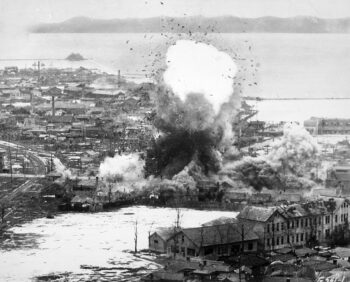
The Korean War, which broke out on June 25, 1950, can be considered the epicenter of bombing as an instrument of war. For one, it was the first—and, so far, the last—time since 1945 that the United States seriously considered using atomic weapons during the course of an imperial war. It was the first war that the United States did not win. It ended in a stalemate—an armistice—that continues until today. Kinetic fighting was suspended, but the war continues (though only by one side) by what is conveniently but simplistically called sanctions.
December 1, 2020
The United States is now in a New Cold War with Russia and China, with the focus increasingly on the latter and involving a direct challenge to U.S. hegemony over the world economy.
October 1, 2020
During the 1960s, China was effectively excluded from the two major camps: the Soviet camp and the U.S. camp. For about a decade, China was obliged to seek development within its own borders and thereby achieved some extent of delinking: a refusal to succumb to U.S.-eurocentric globalization and an embrace of a people's agenda of development. While foreign relations were later normalized and China once again brought in foreign capital, since being explicitly targeted as the primary rival of the United States, however, the situation may again warrant moves toward delinking and searching for alternatives, with ups and downs along the way.
September 1, 2020
Since the emergence of COVID-19, the United States has quite openly decided to use the crisis, at a global scale, as a weapon against its perceived rival, China. In this context, India has taken a number of steps to restructure its relation to China, asserting economic stances and implementing policies that are becoming more and more closely entwined with its geopolitical positions and aspirations.
March 1, 2020
A new poem by Kenneth Salzmann, author of The Last Jazz and Other Poems.
December 1, 2019
In The Killing Season: A History of the Indonesian Massacres, 1965–66, Geoffrey B. Robinson offers the most comprehensive history of Indonesia's mass killings to date, arguing that the army, foreign governments, and monopoly capital must all be jettisoned from the country's ruling coalition for meaningful justice to be achieved.
June 1, 2019
The situation in Venezuela has become extremely dire due to Washington's heightened economic warfare, its continuing attempts to engineer a political coup, and its growing threats of massive military intervention—all aimed at bringing down the Bolivarian Republic. The recent seizure of Venezuelan oil assets in the United States and its gold reserves in British banks, as well as the sanctioning of Venezuelan oil sales, have come on top of a long series of economic sanctions—beginning with the Obama administration and now intensified under Trump's—that constitute nothing less than a modern form of siege warfare, extended to food supplies and medicine. But the Venezuelan Revolution has managed to resist in the face of the economic and political warfare of the most powerful imperialist nation in the world, and the reasons why are to be found in the nature of the Bolivarian Revolution and the Venezuelan people themselves.