October 1, 2020
Zhoujiazhuang is singular, being the only de facto people's commune in China today. At present, Zhoujiazhuang still maintains the political, economic, and social structure that has been essentially in place since 1956. For over sixty years—since ten years before the Cultural Revolution and thirty-eight years after the dismantling of almost all people's communes in 1982—Zhoujiazhuang has survived as an organizational unit over the same territory comprising the same six natural villages.
October 1, 2020
Originally set up in 1998 in China, the Puhan Rural Community was the first peasant-initiated, cross-village organization established after the collapse of the top-down people's communes and the implementation of the household responsibility system. Puhan learned a lesson about the exploitation of usurious microfinance and decided that it was capable of establishing a system of mutual aid credit by itself, changing the cultural emphasis on money. Its story of struggling with rural financial organizations opens up a debate on the trap of marketization and monetization, the root causes of loans and debts, the negotiating power of collectives, the production mode of ecological agriculture, and the redefinition of the commonwealth.
July 1, 2020
Organized labor—based on white-exclusive and later white-dominated, though not necessarily exclusive, trade unions—formed itself as part of the settler state, not in the sense of being an apparatus of the state, but in the sense of accepting certain important precepts. The unions took for granted the nature of the settler state and, as such, conceived that the unions were to exist to serve the "legitimate" population, or at least the working class of the legitimate population.
April 1, 2020
My pop was always working on our house, a shack that was all my parents could afford in the great hunger for homeownership that came after the Second World War. But nothing ever quite got finished, either for lack of funds or motivation. But if he wasn't quite a craftsman himself, he admired craft. He was moved by the effort and intricacy of how things were made. 'Honey, look at this old wooden chest with these lovely silver handles. Think of all the work that was done to this thing by someone's hands.'
April 1, 2020
In 1950, the mainly Mexican and Mexican-American members of the International Union of Mine, Mill and Smelter Workers Local 890 went on strike against Empire Zinc in southern New Mexico. One of the only fair-haired and pale-skinned union men in meetings and jail was Mine Mill organizer Clinton Jencks. Raymond Caballero's study, McCarthyism vs. Clinton Jencks, exhaustively details how the federal government brought the entire weight of its repressive apparatus down on the heads of Jencks, his family, and his union siblings.
March 1, 2020
Seattle in 1919 was an island in a still immeasurable sea of timber. The Pacific coastal forests were estimated to contain nearly two-thirds of the timber in the country, and the Washington State forests accounted for the largest part of these. The physical hardships associated with the lumber industry, including isolation deep within the rain forests, made working conditions an even more miserable burden than low wages. The work was seasonal and layoffs were common; the completion of one job might mean termination and the search for work elsewhere. When the winter rains brought an end to work in the woods, the state's loggers fled to the city, not welcome elsewhere. In some years, there might be thousands on Seattle's streets.
November 1, 2019
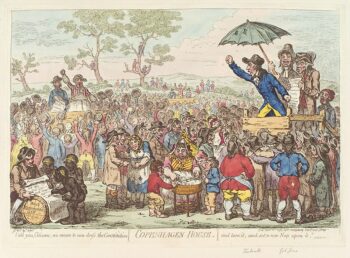
November 5, 2019, is the 225th anniversary of the acquittal of Thomas Hardy on charges of High Treason. Hardy is nearly forgotten today, but for decades workers and democrats in England celebrated November 5 as the anniversary of a major victory, a triumph over a powerful state that had deployed immense resources to crush working-class organizations and suppress popular demands for democratic rights.
October 1, 2019
Costas Lapavitsas's The Left Case Against the EU (Polity, 2019) is recognized as the leading work advocating Lexit, the left-wing case for Brexit, and for nations leaving the European Union more generally. In light of current Conservative British Prime Minister Boris Johnson's commitment to exit the European Union by October 31, even if it means a no-deal Brexit, the role of the left takes on growing importance. Moreover, this raises issues of the European Union generally, including the dominance of neoliberalism within it and the question of German hegemony. Here, Neil Davidson offers an assessment of Lapavitsas's book.
October 1, 2019
In this continuation of the exchange on the European Union, the United Kingdom, and the left, Andy Storey engages with Costas Lapavitsas's arguments in The Left Case Against the EU.
October 1, 2019
As part of the exchange on the European Union, the United Kingdom, and the left, Costas Lapavitsas provides an extensive response to Neil Davidson's and Andy Storey's contributions.