July 1, 2026
This month's "Notes from the Editors," originally published in May by the
German Quarterly, explores the last few decades of U.S. belligerence in Iran, culminating in the Trump administration's recent acts of war in the region. Together with Israel, the Editors write, the United States "has entrapped itself in an imperialist war that it cannot win," thus underscoring the necessity of a global anti-imperialist peace movement.
July 1, 2026
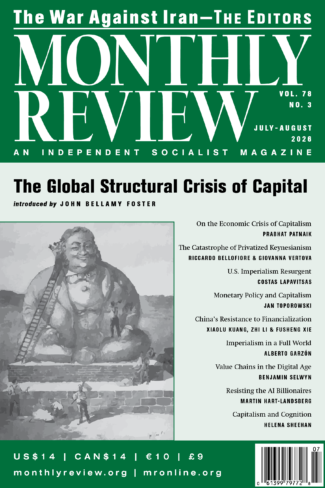
John Bellamy Foster introduces our special summer issue on the "Structural Crisis of Capital," illuminating its four main characteristics as first outlined by István Mészáros in
Marx's Theory of Alienation. Capital, Foster says, has found itself in a position akin to Lucian's sorcerer's apprentice: futilely attempting to control a runaway system that he had himself created, accumulating not only contradictions but outright catastrophe—with globe-spanning consequences.
July 1, 2026
Considering the "Structural Crisis of Capital" from the perspective of economics, Prabhat Patnaik sheds light on two major aspects that have risen to prominence in our current conjuncture. The first, rampant stagnation and unemployment, is clear and undeniable. The second, particular to the capitalism of the late twentieth century and the shedding of colonies on which imperial nations depended for wealth is particularly salient to Trump's economic strategy of economic recolonization not only through soft power, but direct military action.
July 1, 2026
"Old-style neoliberalism," write Riccardo Bellofiore and Giovanna Vertova "is dead, or at least gravely ill. The new paradigm that may replace it has not yet been born or is not yet recognizable. In the middle, between the times, lies what we have proposed to call the
permanent catastrophe: a regime in which capitalist responses in catastrophic form have become the norm, in which crises are no longer overcome but accumulate."
July 1, 2026
It is quite evident, Costas Lapavitsas begins, that the world is currently ensnared in geopolitical turmoil, perhaps for over a decade. In this article, Lapavitsas provides insight into the inseparable and interlocking mechanisms of dollar dominance and imperialism backed by the escalatory militarism of the second Trump administration. As Lapavitsas notes: "The dollar and the F-35—monetary coercion and military power—are two moments of a single structure of domination."
July 1, 2026
Jan Toporowski explains our contemporary age of "monetary policy dominance": the era in which the setting of short-term interest rates by the central banks is seen as the key instrument for regulating economic activity. This, however, does not reflect an ironclad law of the business cycle but, rather, a set of assumptions that underscores the dependence of capitalism on the accumulation of capital itself. This in turn obscures deeper truths about the effectiveness of monetary policy on the daily lives of the working class.
July 1, 2026
Over the last half-century, the "financial explosion"—manifest in the unrestrained expansion of financialization and its tools and institutions—has fundamentally reshaped the global economy, impacting countries throughout the Global North and South. China, however, has proven to be a distinctive case. Xiaolu Kuang, Zhi Li, and Fusheng Xie probe the question of how and why China has managed to maintain its emphasis on production above finance, and the development all above the accumulation of capital.
July 1, 2026
Since the wane of mercantilism in Europe, conceptions of wealth, trade, and productivity have also changed: from one of a zero-sum game reliant only on the productivity of land, to one of the potential for positive-sum wealth created by industry, and, now, to the zero-sum neomercantilism necessitated in a world of resource depletion, where the earth is pushed to its biophysical limits. But the response to this crisis does not have to be further fortification—it could also be a world that organizes itself within the metabolic limitations of nature.
July 1, 2026
In order to comprehend the environmental crisis that goes hand-in-hand with the "Structural Crisis of Capital," we must also understand the nature of global value chains and how they contribute to environmental degradation and worker exploitation on a global level. Benjamin Selwyn elucidates how global value chains and digitalization sit within a "conjoined dynamic of labor-exploitative accumulation and ecological expropriation."
July 1, 2026
Martin Hart-Landsberg gives an in-depth account of the oligarchs of Silicon Valley and their embrace of transhumanist ideologies that celebrate individualism and technological advancement above all else. However, he asserts, all is not lost, as growing dissatisfaction with capitalism "is slowly but steadily helping to grow a movement of resistance"—a resistance that must recognize that it is not just tech billionaires but capitalism itself threatening humanity's chance at a better future.