July 1, 2025
Sit Tsui and Lau Kin Chi elucidate the history of China's People's Communes as told through the lens of three present-day rural villages. In these villages, they observe the effects of the project's dismantling and diminishing collective ownership and land management, with the conclusion that a return to collectivism is vital for carrying forward the socialist project.
June 1, 2025
This month, the editors dive into the history of Nazi Germany for a discussion of
Gleichschaltung, which in this instance describes the "falling into line" of institutions and individuals under fascism. As the editors point out, the extralegal and norm-breaking actions may be justified rhetorically by the fascist regime but require the acquiescence of the larger society in order to become effective—a process we are currently watching in real time.
June 1, 2025
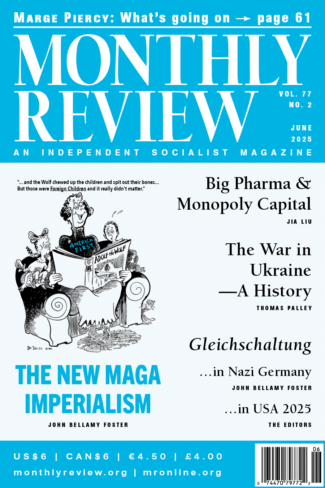
In this third installment of
MR's series on the MAGA movement, John Bellamy Foster explores the dramatic shift in U.S. imperialism that began with the first Trump presidency and has accelerated in his second. The shift, Foster explains, is not one driven by anti-imperialism and anti-militarism but rather represents a hard shift to the right fueled by hypernationalism and the goal of recapturing U.S. power on the world stage.
June 1, 2025
A new poem by Marge Piercy.
June 1, 2025
In this excerpt from John Bellamy Foster's
Trump in the White House (Monthly Review Press, 2017), Foster expands on the concept, origins, and practical effects of
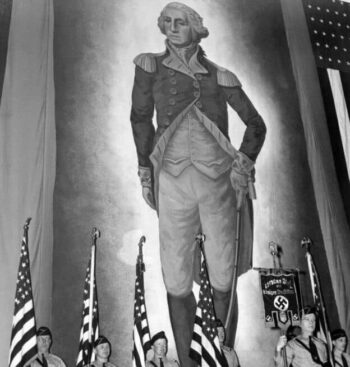
Gleichschaltung (falling into line) in Nazi Germany and its relevance today. As Foster writes "to put such a neo-fascist strategy in place requires a new kind of
Gleichschaltung"; one in which all of society—from the judiciary to Congress to cultural and media institutions—are brought into line.
May 1, 2025
In the Notes from the Editors,
MR editors dissect the true meaning behind the right-wing obsession with "Cultural Marxism" and its use to justify the right-wing takeover of the administrative state and the spread of the New McCarthyism threatening all those who oppose the administration. However, the editors point out, what the right fears is not a culturally based, postmodern approach to Marxism, but Marxism as it is historically and materially grounded and its true potential for building a proletarian movement against fascism.
May 1, 2025
John Bellamy Foster presents a rogue's gallery of the fascist ideologues insidiously pushing the MAGA agenda, from the Heritage Foundation and its Project 2025 to neo-Nazi YouTubers and cultural influencers. "The political and ideological successes of the MAGA movement," Foster writes, "were made possible in part by a liberal-left that abandoned the working class economically and politically."
May 1, 2025
As we mourn the loss of prolific
MR author and media advocate Robert W. McChesney, we are grateful to be able to publish an excerpt from his introduction to John Bellamy Foster's
Trump in the White House (Monthly Review Press, 2017). In this insightful analysis, McChesney explains how neoliberal restructuring prepared paved the way for Trump and the neofascist MAGA movement to reach the dizzying heights of power that they have reached today.
May 1, 2025
Pranay Somayajula dives deep into how the idea of decolonization has taken hold both theoretically and practically, showing how its deployment by the fascist Hindutva movement to justify anti-Muslim oppression reveals a latent threat: potential cooptation by actors seeking to promote nationalist identities in postcolonial contexts. Somayajula concludes that what is needed is a "return to a materially grounded understanding of empire and resistance," adding that "Any version of decolonization…placing a greater importance than the abstract than the material is a 'decolonization' that has lost its way."
May 1, 2025
In this contribution to the further development of socialism with Chinese characteristics Cheng Enfu and Yang Jun offer their "Theory of Triple Revolution," enumerating the historical stages of the Chinese Revolution and analyzing its current trajectory. A complete revolutionary view of Marxism in China, they conclude, "will advance the spirit of the revolution to its completion….[moving] forward along the correct track of Marxism, such that a powerful revolutionary vision will open up before us."