September 1, 2026
Taking as a starting point two classic works of the mid-nineteenth century—Benjamin Disraeli's
Sybil; or the Two Nations and Frederick Engels's
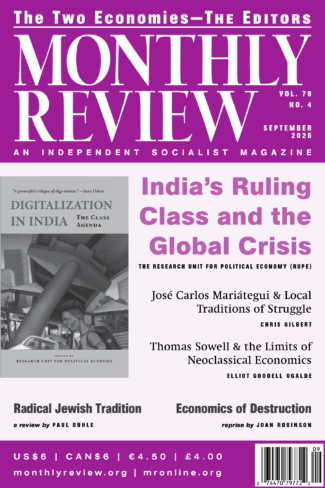
The Condition of the Working Class in England—this month's "Notes from the Editors" explores the way both authors articulated the plight of workers in their own era, drawing key parallels to our own time. The similarities are particularly conspicuous when examining the so-called affordability crisis, exposing the regime of social murder that accompanies the increasing polarization of economic life.
September 1, 2026
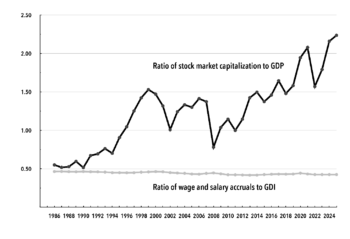
In September's Review of the Month, the Research Unit for Political Economy delves into how the crisis pervading the world system, on stark display in the tech sector, global finance, and the sphere of production, lays bare the longstanding vulnerabilities of the Indian economy. As the contradictions in the neoliberal phase become unmistakable, the authors write, it is necessary to take a class-based approach to resolving the questions of how to bring about key questions regarding the productive life and development of India.
September 1, 2026
The relationship between Marxism and other revolutionary traditions is a key question for our time. If we approach the issue incorrectly, we risk Eurocentrism and underrecognizing Marxism's role in the Global South contexts where it is most vital and active. This article examines and extends José Carlos Mariátegui's dialectical approach to the issue, which demonstrates how Marxism is not diluted but strengthened through engagement with the thought and practice of existing struggles, while those struggles can, in turn, gain greater depth and groundedness through the same relationship.
September 1, 2026
Through the work of neoclassical economist Thomas Sowell, Elliot Goodell Ugalde dissects the orthodox view that takes for granted that scarcity is at the center of economic life. In a world of various kinds of surpluses, Goodell argues, the idea that scarcity is the only organizing principle of our economic is inadequate to describe the complex interactions of institutions, history, and social power that make up economic organization under capitalism.
September 1, 2026
In this 1980 talk by Joan Robinson, first published in
MR in 1983, the economist painted a stark picture of global arms race fueled by military capitalism and imperialism. "The important question," she urged, "is not whether the rate of inflation is high or low or can be brought under control but whether our generation will succeed in destroying the world…. Economics should begin to address the important issue of our impending doom."
September 1, 2026
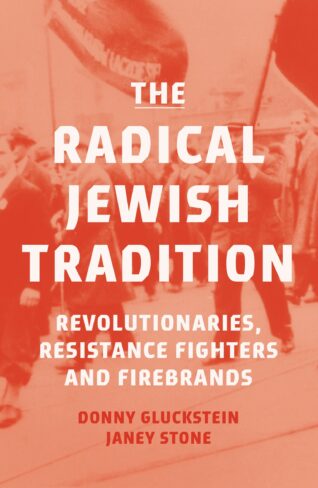
Paul Buhle reviews
The Radical Jewish Tradition by Donny Gluckstein and Janey Stone. The book, Buhle writes, is a window onto "the antinomies of nineteenth-century Jewish life"—including the growing movement against Zionism and for socialism among Eastern European Jews. This authors, Buhle notes, also tells the story of Jewish communists in Britain, the United States, and beyond, taking into account the wide sweep of Jewish left activity globally, situating the present struggles against genocide in Palestine squarely within the legacy of radical Jews everywhere.