April 1, 2025
Yumeng Liu takes a deep dive into the history of Laos, the only socialist nation among the Theravāda Buddhist countries of Southeast Asia, examining how the country has developed its own particular approach to socialism, influenced by both local Buddhist beliefs and Marxist ideology. Liu also explores the historical and present-day tensions inherent in this uniquely Lao approach to socialist development.
March 1, 2025
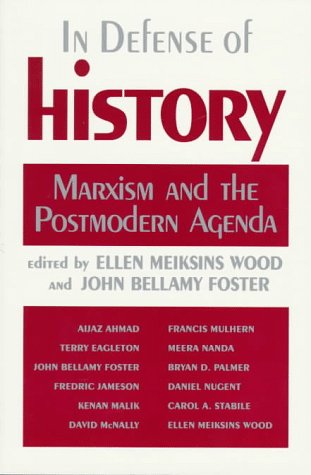
In this excerpt from Ellen Meiksins Wood's
In Defense of History, Wood appraises the state of postmodern thought in the late twentieth century. "Today's postmodernism," Wood writes, "for all of its apparently defeatist pessimism, is still rooted in the 'Golden Age of Capitalism.' It's time to leave that legacy behind and face today's realities."
March 1, 2025
Torkil Lauesen delves into the legacy of celebrated Arghiri Emmanuel, whose theory of unequal exchange resonates well into the twenty-first century. Introduced in 1962, Emmanuel's critique of Ricardian and neoliberal capitalism further illuminated the Marxist concept value as it relates to global exchange and the ongoing exploitation of the Global South by the Global North.
March 1, 2025
Using data from Brazil's Integrated System of Household Surveys, Renata Falavina and Gabriel Ulbricht employ Marxist categories in order to illuminate the concept of the reserve army of labor in the context of underemployment and informal labor in modern-day Brazil. This view, the authors write, shows that the dichotomy of full employment and unemployment fails to capture the complexity of unstable labor dynamics in a world of informal and precarious work.
February 1, 2025
Since the 1980s, writes Lu Xinyu, a division between industrial and agricultural labor has grown in China, reflected in the fractured relationship between urban and rural areas. China's successful navigation of the issue, Lu concludes, relies on creating a vigorous alliance between the rural peasantry and urban workers that aids in the ultimate delinking of China from the imperialist, world system. Chinese-style modernization, Lu concludes, represents a path that, while developed in a Chinese context, "represents the aspirations of the Global South to break free from worldwide Western hegemony."
February 1, 2025
In this deeply stirring account, Sit Tsui and Lau Kin Chi share their field research, conducted over years of travel and relationship-building, into the Japanese antinuclear movement. As the people and environment of Fukushima continue to be impacted by the disaster at the Fukushima Daiichi power plant in March 2011, the No-Nukes movement has grown in response, encompassing aspects of society ranging from artists and monks to fisherfolk and intellectuals.
January 1, 2025
In this talk given at Peking University in October 2024, John Bellamy Foster shares ten theses describing both the roots and contemporary manifestations of the idea of ecological civilization. Relating the concept's origins in the writings of Marx and Engels to its expression today in Chinese society, Foster reveals the inherently socialist nature of eco-civilization and the necessity of a worldwide ecological revolution to shift toward sustainable human development.
January 1, 2025
Against a backdrop of political turmoil and a popular uprising, Aasim Sajjad Akhtar examines how the contradictions of liberal democracy have played out in Pakistan. Exploring the dynamic between the U.S.-backed, militarized Pakistani political elite and the rise of reactionary politician Imran Khan, Akhtar shows how Khan has employed empty anti-imperialist rhetoric to mobilize a discontented populace—and how this could be counteracted with a genuine anti-imperialist movement.