September 1, 2020
Crisis reveals the fault lines in society. COVID-19 is wreaking havoc on our health and killing us in large numbers, bringing with it the most massive and steep economic collapse in U.S. history. Then, there was the murder of George Floyd and the resulting astonishing global protests against racism. Anyone can see that capitalism, facing no real opposition in decades, has reverted to its default position: only profit rules us and those with money will beat down those with none, without mercy or remorse.
September 1, 2020
Since the emergence of COVID-19, the United States has quite openly decided to use the crisis, at a global scale, as a weapon against its perceived rival, China. In this context, India has taken a number of steps to restructure its relation to China, asserting economic stances and implementing policies that are becoming more and more closely entwined with its geopolitical positions and aspirations.
September 1, 2020
Among ethnic disasters of the past few decades, few can match in intensity or have been reported in the media more extensively than those of the Indigenous in Guatemala. The social structure of the nationÑits hierarchy, driven by a light-skinned population, most of whom are ethnically mestizo but who do not identify with the purely IndigenousÑits history, and its small size make it an important site for the documentation and reporting of ethnic disputes and differences.
July 1, 2020
The entire United States has been upended by weeks of protests, extending to over 150 cities, sparked by the racist police murder of George Floyd. The present special issue of Monthly Review is devoted to exploring the complex interweaving of the classical Marxian critique with the rapidly developing critique of racial capitalism.
July 1, 2020
Indigenous and African resistance and intellectual traditions provide key insights to the very nature of capitalism and how it has unfolded throughout space and time, its tentacles emanating from Europe and stretching across the globe in the forms of imperialism and colonialism.
July 1, 2020
In recent years, "racial capitalism" has ascended across the humanities and social sciences. It has arisen as a conceptual framework to understand the mutually constitutive nature of racialization and capitalist exploitation, inter alia, on a global scale, in specific localities, in discrete historical moments, in the entrenchment of the carceral state, and in the era of neoliberalization and permanent war.
July 1, 2020
Organized labor—based on white-exclusive and later white-dominated, though not necessarily exclusive, trade unions—formed itself as part of the settler state, not in the sense of being an apparatus of the state, but in the sense of accepting certain important precepts. The unions took for granted the nature of the settler state and, as such, conceived that the unions were to exist to serve the "legitimate" population, or at least the working class of the legitimate population.
July 1, 2020
Poultry-processing work lies within a larger web of carceral geographies that extend beyond the prison walls into factory floors, neighborhoods, and schools. These geographies depend on and are produced through racism, as the production of unequal vulnerability to premature death. Racial capitalism connects the poultry plant to the prison alongside the movement for abolition beyond the prison.
July 1, 2020
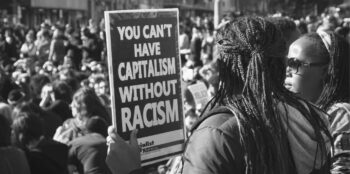
Capitalism is a global racialized structure. Although many of the exploited working class are white peoples, people of color, especially women of color, have generally borne the brunt of the human suffering inflicted by capitalism. There is no doubt that colonialism and U.S. slavery were economic systems, but they were also brutal attacks on non-Western peoples.
July 1, 2020
COVID-19 is a great revealer, laying bare the structures of racial disposability that have sacrificed people, from migrant detainees to meat packers. We are also witness to the rise of anti-Asian violence. Brutal attacks against Asian Americans have exposed the fraudulence of the model minority myth and the assimilationist paradigm that legitimizes state violence against Black and Brown bodies.