June 1, 2021
The death of Salvador Allende in 1973 marked, simultaneously, not only the demise of one of the great socialist experiments, and the launching of neoliberalism; it also represented the loss in Allende of one of the great figures in social medicine. Nowhere has neoliberalism had more devastating effects than in the destruction of public health and social medicine initiatives throughout the world.
April 1, 2021
In Socialist Practice, a collection of essays on leftist theory and experiences, Victor Wallis adheres to the view that the achievement of socialism is a drawn out, nonlinear process consisting of episodes that in many cases have a mixed impact on the revolutionary cause. He analyzes several, ranging from the seven decades of Soviet rule to the New Left of the 1960s. His main thesis is that over the last century pure socialism has never existed and that on all fronts socialist movements and governments have contained elements of the old—namely, capitalism.
March 1, 2021
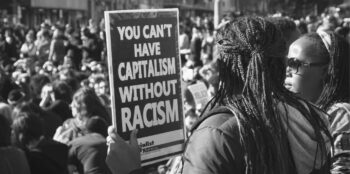
The COVID-19 pandemic has brought into sharp relief the deep structural problems affecting nonwhite racialized workers in the core and periphery. Yet, many social scientific analyses of the global political economy, at least in the pre-COVID era, are race neutral or willfully indifferent to the persistent racial pattern of global inequalities. Even if they do address legacies of colonialism, they ignore the ongoing racial logics of oppression embedded therein.
March 1, 2021
Capitalist modernity not only contains profound contradictions, but is also undergoing a significant transformation. Far from acting as a driving force for the development of social productive forces, it has become a parasitic entity with an essentially rentier and speculative function. Underlying this is an institutional framework that favors the private appropriation and the concentration of the products of general intellect.
February 1, 2021
On California's November 2020 ballot were some contentious and important issues, including Proposition 22, classifying rideshare drivers and app-based delivery workers as independent contractors. Gig economy giants Uber, Lyft, Doordash, and others spent a whopping $111 million on Prop 22. Of course, the companies had a lot to lose. If they were made to treat their drivers or delivery people as employees and compensate them accordingly, they would be bankrupted, they claimed.
November 1, 2020
As stated in the United Nations Universal Declaration of Human Rights, health is a fundamental human right. However, we find ourselves in the midst of the COVID-19 pandemic with a shortage of both human and material health resources, most of which must be sourced from the private sector. Some of the wealthiest countries—France, Italy, Spain, the United Kingdom, and the United States—have proved unable to respond rapidly. The evolution of public health over the past four decades, during which government health policies have reduced health services to commodities and objects of speculative investment, has led to the current crisis.
November 1, 2020
The story of the consumer's involvement in the sphere of production is not new, as consumers have been providing unpaid labor to and otherwise subsidizing capitalism since at least the mid–twentieth century. Yet, as the economy has evolved so too have the scope and complexity of consumer work.
September 1, 2020
Crisis reveals the fault lines in society. COVID-19 is wreaking havoc on our health and killing us in large numbers, bringing with it the most massive and steep economic collapse in U.S. history. Then, there was the murder of George Floyd and the resulting astonishing global protests against racism. Anyone can see that capitalism, facing no real opposition in decades, has reverted to its default position: only profit rules us and those with money will beat down those with none, without mercy or remorse.
September 1, 2020
A new poem by Marge Piercy.
July 1, 2020
In recent years, "racial capitalism" has ascended across the humanities and social sciences. It has arisen as a conceptual framework to understand the mutually constitutive nature of racialization and capitalist exploitation, inter alia, on a global scale, in specific localities, in discrete historical moments, in the entrenchment of the carceral state, and in the era of neoliberalization and permanent war.