November 1, 2025
Helena Sheehan reflects on the evolution of her intellectual political relationship to China, a journey that began with limited knowledge of a seemingly far-away land and ends with a nuanced understanding grounded in her on-the-ground experiences as a visiting professor at Peking University. Through political and cultural analysis, Sheehan gives readers a peek into what how the Chinese Revolution continues to unfold.
July 1, 2025
This month's "Notes from the Editors" discusses the accelerating progress of China toward sustainability. China's decline in carbon emissions and rapidly decarbonizing energy sector demonstrates the importance of societal realignment and extensive planning to shift toward the ecological modernization that has continued to elude monopoly-capitalist regimes.
July 1, 2025
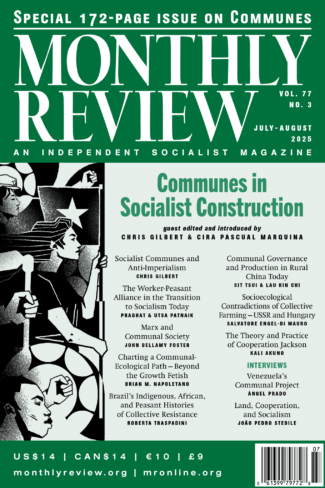
Inspired by the Venezuelan project of building socialism via the commune, this special issue looks at attempts to use communal models in socialist projects in a range of different contexts, as well as the theoretical bases for such an endeavor. In their introduction, guest editors Chris Gilbert and Cira Pascual argue that the theme of
Communes in Socialist Construction is an important opportunity for engaged Marxist reflection of a kind that offers valuable contributions to the universal body of socialist thought.
July 1, 2025
Sit Tsui and Lau Kin Chi elucidate the history of China's People's Communes as told through the lens of three present-day rural villages. In these villages, they observe the effects of the project's dismantling and diminishing collective ownership and land management, with the conclusion that a return to collectivism is vital for carrying forward the socialist project.
July 1, 2025
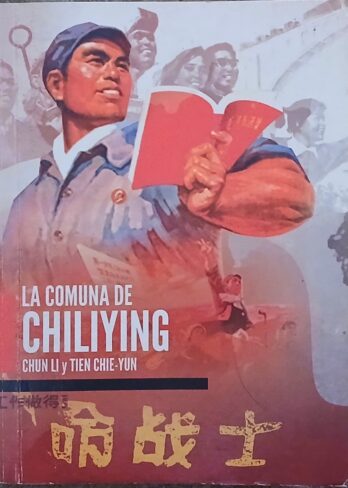
Inside a People's Commune is a short 1974 book documenting life in the Chiliying Commune, one of the earliest in revolutionary China. The text explores the commune's organization, challenges, achievements, and mass-based character. Hugo Chávez later drew inspiration from the book, citing it when launching Venezuela's communal project. Today, it continues to serve as a pedagogical tool for Venezuelan communards working to build a unified system of socialist self-government.
June 1, 2025
In an age of cutting-edge medical science, how do the world's largest pharmaceutical companies stifle innovation in order to juice profits and remain competitive in the international markets? The answer, Jia Liu writes, can be found in the concept of monopoly capitalism. This brand of "intellectual monopoly capitalism," she notes, contributes to "a logic of expropriation and rent-seeking," leading in turn to "closed science and declining medical innovation."
May 1, 2025
In this contribution to the further development of socialism with Chinese characteristics Cheng Enfu and Yang Jun offer their "Theory of Triple Revolution," enumerating the historical stages of the Chinese Revolution and analyzing its current trajectory. A complete revolutionary view of Marxism in China, they conclude, "will advance the spirit of the revolution to its completion….[moving] forward along the correct track of Marxism, such that a powerful revolutionary vision will open up before us."
April 1, 2025
What is ecological civilization? In this article, Chen Yiwen presents a dialectical analysis that illuminates the theoretical and practical elements of ecological civilization, particularly as it develops in the context of China. In China, she notes, significant progress has been made, but there remain outstanding questions that must be resolved during the transition to an ecologically harmonious society that promotes global equality and human flourishing.
April 1, 2025
Yumeng Liu takes a deep dive into the history of Laos, the only socialist nation among the Theravāda Buddhist countries of Southeast Asia, examining how the country has developed its own particular approach to socialism, influenced by both local Buddhist beliefs and Marxist ideology. Liu also explores the historical and present-day tensions inherent in this uniquely Lao approach to socialist development.
February 1, 2025
Since the 1980s, writes Lu Xinyu, a division between industrial and agricultural labor has grown in China, reflected in the fractured relationship between urban and rural areas. China's successful navigation of the issue, Lu concludes, relies on creating a vigorous alliance between the rural peasantry and urban workers that aids in the ultimate delinking of China from the imperialist, world system. Chinese-style modernization, Lu concludes, represents a path that, while developed in a Chinese context, "represents the aspirations of the Global South to break free from worldwide Western hegemony."