February 1, 2026
Paul Buhle reviews
Insectopolis: A Natural History, a new graphic novel by Peter Kuper. In the book, Kuper, a prolific producer and publisher of left-wing comics, spins a tale of two siblings who find themselves in a world of insects. Through encounters with butterflies, beetles, ants, and more, Kuper reveals the deep entanglements between human society—at its best and worst—and the creatures of its living environment.
January 1, 2026
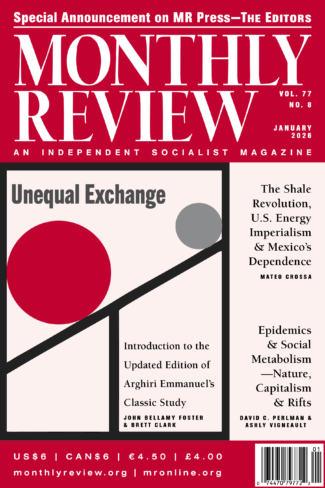
This month's "Notes from the Editors" celebrates the accomplishments of Michael Yates, who is retiring as editorial director of Monthly Review Press. Michael's books and articles have had a tremendous impact on the work of Monthly Review as a whole, and will be sorely missed. The editors also welcome the new editorial director of the Press, Arun Kundnani, an accomplished scholar who promises to carry on the MR tradition while bringing a fresh perspective to our collective efforts.
January 1, 2026
In this Introduction to the updated edition of
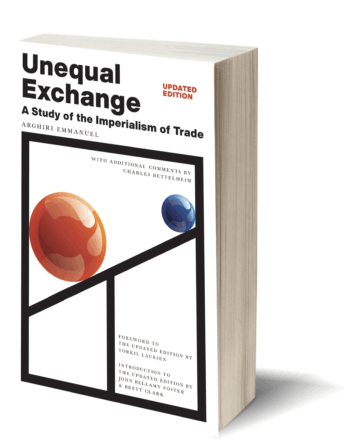
Unequal Exchange by Arghiri Emmanuel, published by Monthly Review Press, John Bellamy Foster and Brett Clark offer readers insight into the continuing influence of Emmanuel's seminal work. Through both deep understanding thoughtful critique, the authors deftly situate Emmanuel's text as an indispensable part of an enduring tradition of Marxist analysis of the global dynamics of labor.
January 1, 2026
David E. Perlman and Ashly Vigneault explore the linkages between humanity's metabolic rift with nature and the accelerating emergence of epidemics, which are fundamentally related to the capitalist mode of production and concomitant alienated social metabolism. Using historical and epidemiological research that extends from the rise of the bubonic plague to the emergence of COVID-19, Perlman and Vigneault are able to deftly tie these concepts to the breach of planetary boundaries that threatens all of humanity.
January 1, 2026
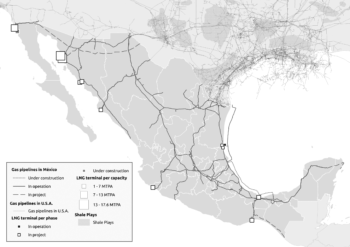
Mateo Crossa delineates the history of U.S. imperialism in Mexico through the lens of its domination of the fossil fuel industry, particularly by way of the Shale Revolution and the advent of fracking. "By engineering new regional dependencies and reshaping energy alliances to suit is strategic ambitions," Crossa writes, "the United States weaponized its command over natural gas to deepen its grip on the global fossil energy system and reinforce its imperial reach."
December 1, 2025
As part of our special issue on the legacy of former
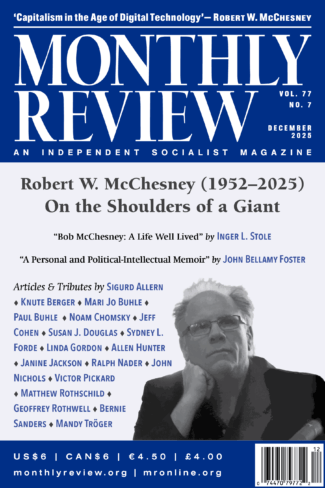
MR coeditor Robert W. McChesney, December's "Notes from the Editors" revisits his prescient insight into the rise of neofascism in the U.S. While the threat is undeniable, he wrote, "the good news…is that there is nothing inexorable about the victory of fascism. There is another road out, and that road is socialism."
December 1, 2025
John Bellamy Foster introduces our special issue celebrating the life and work of
MR former coeditor and MR Press author Robert W. McChesney. In his recounting of over 50 years of close friendship and collaboration, Foster paints a portrait of McChesney as a visionary intellectual and activist whose work will reverberate through the communication field for decades to come.
December 1, 2025
In this deeply personal essay, communication scholar Inger Stole shares with readers a glimpse into her life with Robert W. McChesney, her husband of 37 years. Stole reveals the depth of feeling with which McChesney approached all aspects of life, from his work as an intellectual and advocate to his role as a father and life partner.
December 1, 2025
John Nichols, Robert W. McChesney's longtime collaborator and frequent coauthor, celebrates McChesney's near-clairvoyant thought and scholarship. Nichols notes that McChesney's impressive foresight enabled him to see the pitfalls of the digital age long before the Internet became a tool for the worst impulses of the elites under capitalism.
December 1, 2025
Matthew Rothschild looks back on nearly 40 years working alongside his friend and colleague Robert W. McChesney. McChesney, he writes, brought to the world a sharp analysis of not only the contradiction between corporate media and democracy, but between the capitalist system as a whole and a true democracy that serves the people.