October 1, 2020
In the twenty-first century, all signs are pointing to another period of hegemonic struggle over the world economy, this time between the United States and China, although complicated in this case by the unique, indeterminate aspects of the post-revolutionary Chinese social formation, which is neither entirely capitalist nor entirely socialist.
October 1, 2020
In 2018, Washington launched the trade war against China. Measures included sharply increasing the customs tariffs borne by certain products imported from China, further barriers to imports from China, and sanctions against Chinese companies targeted by bans on the use of U.S.-made inputs. By June 2019, as tariff increases hit new sectors, China was no longer the United States's largest trading partner.
October 1, 2020
During the 1960s, China was effectively excluded from the two major camps: the Soviet camp and the U.S. camp. For about a decade, China was obliged to seek development within its own borders and thereby achieved some extent of delinking: a refusal to succumb to U.S.-eurocentric globalization and an embrace of a people's agenda of development. While foreign relations were later normalized and China once again brought in foreign capital, since being explicitly targeted as the primary rival of the United States, however, the situation may again warrant moves toward delinking and searching for alternatives, with ups and downs along the way.
October 1, 2020
Originally set up in 1998 in China, the Puhan Rural Community was the first peasant-initiated, cross-village organization established after the collapse of the top-down people's communes and the implementation of the household responsibility system. Puhan learned a lesson about the exploitation of usurious microfinance and decided that it was capable of establishing a system of mutual aid credit by itself, changing the cultural emphasis on money. Its story of struggling with rural financial organizations opens up a debate on the trap of marketization and monetization, the root causes of loans and debts, the negotiating power of collectives, the production mode of ecological agriculture, and the redefinition of the commonwealth.
September 1, 2020
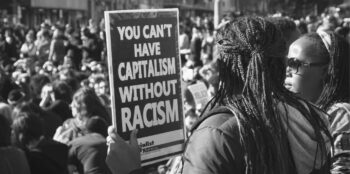
Crisis reveals the fault lines in society. COVID-19 is wreaking havoc on our health and killing us in large numbers, bringing with it the most massive and steep economic collapse in U.S. history. Then, there was the murder of George Floyd and the resulting astonishing global protests against racism. Anyone can see that capitalism, facing no real opposition in decades, has reverted to its default position: only profit rules us and those with money will beat down those with none, without mercy or remorse.
September 1, 2020
Since the emergence of COVID-19, the United States has quite openly decided to use the crisis, at a global scale, as a weapon against its perceived rival, China. In this context, India has taken a number of steps to restructure its relation to China, asserting economic stances and implementing policies that are becoming more and more closely entwined with its geopolitical positions and aspirations.
September 1, 2020
Among ethnic disasters of the past few decades, few can match in intensity or have been reported in the media more extensively than those of the Indigenous in Guatemala. The social structure of the nationÑits hierarchy, driven by a light-skinned population, most of whom are ethnically mestizo but who do not identify with the purely IndigenousÑits history, and its small size make it an important site for the documentation and reporting of ethnic disputes and differences.
September 1, 2020
A new poem by Marge Piercy.
July 1, 2020
In recent years, "racial capitalism" has ascended across the humanities and social sciences. It has arisen as a conceptual framework to understand the mutually constitutive nature of racialization and capitalist exploitation, inter alia, on a global scale, in specific localities, in discrete historical moments, in the entrenchment of the carceral state, and in the era of neoliberalization and permanent war.
July 1, 2020
Organized labor—based on white-exclusive and later white-dominated, though not necessarily exclusive, trade unions—formed itself as part of the settler state, not in the sense of being an apparatus of the state, but in the sense of accepting certain important precepts. The unions took for granted the nature of the settler state and, as such, conceived that the unions were to exist to serve the "legitimate" population, or at least the working class of the legitimate population.