June 1, 2025
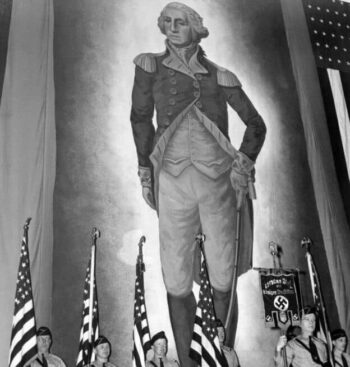
In this excerpt from John Bellamy Foster's
Trump in the White House (Monthly Review Press, 2017), Foster expands on the concept, origins, and practical effects of
Gleichschaltung (falling into line) in Nazi Germany and its relevance today. As Foster writes "to put such a neo-fascist strategy in place requires a new kind of
Gleichschaltung"; one in which all of society—from the judiciary to Congress to cultural and media institutions—are brought into line.
March 1, 2025
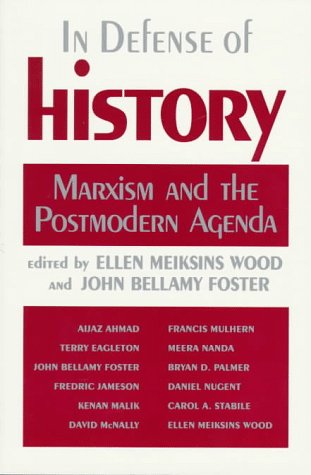
In this excerpt from Ellen Meiksins Wood's
In Defense of History, Wood appraises the state of postmodern thought in the late twentieth century. "Today's postmodernism," Wood writes, "for all of its apparently defeatist pessimism, is still rooted in the 'Golden Age of Capitalism.' It's time to leave that legacy behind and face today's realities."
February 1, 2025
Over the last quarter century—and especially since the beginning of Israel's latest genocidal incursion into Palestine in October 2023—the term "settler colonialism" has proliferated in academic and popular discourse. In February's "Review of the Month," John Bellamy Foster connects readers to thinkers from around the globe and across time to illustrate the phenomenon of settler colonialism as a dimension of imperialism, and thus capitalism, driven by a rapacious extractivism that threatens the whole of humanity.
January 1, 2025
This month, we at MR had the great pleasure of publishing this note on Roxanne Dunbar Ortiz's Indigenous Peoples' History of the United States: A Graphic Interpretation, written by Dylan Davis and Paul Buhle, with illustrations from the book by illustrator Paul Peart-Smith.
December 1, 2024
John Bellamy Foster returns to his impactful Marx's Ecology (Monthly Review Press, 2000), for this new introduction for the recent German translation of the book (Marx' Ökologie, Edition Assemblage, 2024). "There is no longer any question," he concludes, "about the depth of Marx's metabolic critique…or its centrality in terms of the philosophy of praxis in our day."
November 1, 2024
In this deep dive into the world of artificial intelligence, Pietro Daniel Omodeo employs the frameworks laid out in Matteo Pasquinelli's The Eye of the Master to weave a sociological history of AI that begins with the class struggles of the Industrial Revolution and continues into the context of early twentieth-century computing, which eventually gave rise our current Information Age. "AI," he concludes, "sheds light onto the intellectual component of labor in all ages."
November 1, 2024
Say Burgin reviews Stayed on Freedom: The Long History of Black Power through One Family's Journey, an account of the fight for Black Power as told through the Simmons family, and particularly, Michael and Zoharah Simmons, from their first meeting during SNCC's Atlanta Project to their later painful struggles as a family. The story that shines through, Burgin writes, is a story of Black Power that is deeply personal, often messy, and, above all, a refreshing challenge to popular narratives that serve to demonize the history of Black Power and the radicals who devoted their lives to the struggle.
October 1, 2024
Shakespeare's Richard III famously immortalized the eponymous king as a scoundrel and tyrant, thirsty for power and blood. Using economic data spanning centuries, Thomas Lambert questions the truth of this spurious reputation: Was Richard III indeed a murderous despot bent on absolute rule? Or a myth propagated by Tudor allies aiming to ingratiate themselves to the new dynasty?
September 1, 2024
Bernard D'Mello describes India's role as a collaborator in the U.S. anti-China Indo-Pacific project. This role, he elaborates, grows directly from the imperial/sub-imperial relationship between the United States and India, which manifests itself in border disputes, military exercises, diplomacy, economic ties, and more, has heightened hostilities in the Indo-Pacific region while benefiting the power elite of both countries.
July 1, 2024
John Bellamy Foster and Brett Clark introduce this summer's special issue on "Imperialism in the Indo-Pacific," exploring how the super-region came to be conceptualized among geopolitical strategists and its present-day role in U.S military strategy. "The United States," they write, "facing the demise of its global hegemonic imperialism, is not only preparing for a Third World War; it is actively provoking it."