March 1, 2026
In 1966, Johns Hopkins hosted a seemingly innocuous international conference titled "The Languages of Criticism and the Sciences of Man," featuring leading figures of what would later be known as "French Theory." However, John Bellamy Foster writes, far from a simple meeting of intellectuals, this represented a "politically motivated attempt to create a beachhead for French structuralism in the United States that would counter the radicalization then taking place."
February 1, 2026
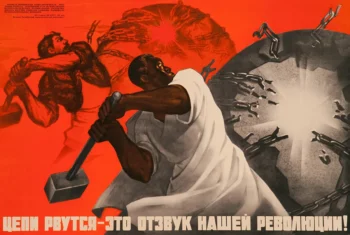
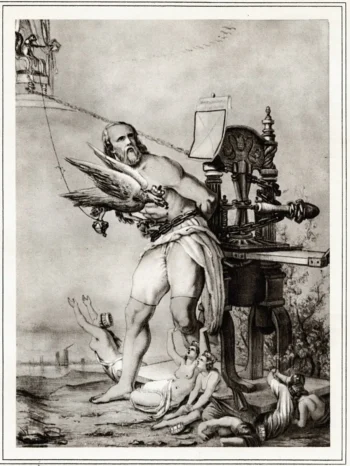
In this talk from the inaugural conference of the Society for Peace, Internationalism, and Ecology, John Bellamy Foster relates the story of Prometheus, as presented in the plays of Aeschylus, to Western Marxism's "dialectic of defeat," in which capitalism is portrayed as an unbreakable bond for the working class. Instead, Foster says, we must recognize Prometheus as a subject who is freed from the seemingly inescapable fetters imposed upon him.
February 1, 2026
Speaking before at the Opening Ceremony of the Fourth World Conference on Marxism in Beijing, John Bellamy Foster discusses the development of eco-Marxism and its relation to Marxist theory. Here, Foster argues, "eco-Marxism as we know it today is not simply another branch of Marxism," but is a pathway to the projects of complete socialism and ecological civilization.
January 1, 2026
In this Introduction to the updated edition of
Unequal Exchange by Arghiri Emmanuel, published by Monthly Review Press, John Bellamy Foster and Brett Clark offer readers insight into the continuing influence of Emmanuel's seminal work. Through both deep understanding thoughtful critique, the authors deftly situate Emmanuel's text as an indispensable part of an enduring tradition of Marxist analysis of the global dynamics of labor.
December 1, 2025
John Bellamy Foster introduces our special issue celebrating the life and work of
MR former coeditor and MR Press author Robert W. McChesney. In his recounting of over 50 years of close friendship and collaboration, Foster paints a portrait of McChesney as a visionary intellectual and activist whose work will reverberate through the communication field for decades to come.
November 1, 2025
In Aeschylus’s play
Prometheus Bound, the Prometheus is a revolutionary figure. Defying divine interdiction to bring fire to humanity, the Titan has since been adopted by thinkers from the Enlightenment to today to represent revolutionary forces in human existence. So, John Bellamy Foster asks in November’s Review of the Month, what is “Prometheanism,” and how has the term been used (and misused) in discussions of Marx, the ecological crisis, and sustainable human development?
October 1, 2025
In this interview with Xu Tao and Lv Jiayi, John Bellamy Foster discuss the history and present of ecological Marxism. Foster explores origins of the term
Anthropocene and its predecessors, the concept of degrowth, the continuing influence of metabolic rift theory, and the cutting-edge issues facing young scholars of degrowth today.
July 1, 2025
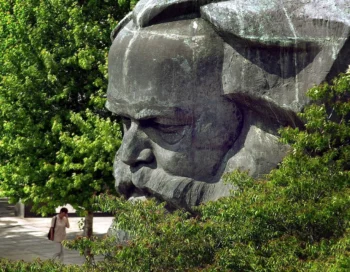
In this innovative study, John Bellamy Foster gets to the heart of Marx's writing on communal societies—an aspect of Marx's work that is often overlooked, despite its importance to the socialist project. Tying together Marx's studies of anthropology, history, and ethnology, Foster illuminates the centrality of communalism to Marx's overall critique of class-based societies.
June 1, 2025
In this third installment of
MR's series on the MAGA movement, John Bellamy Foster explores the dramatic shift in U.S. imperialism that began with the first Trump presidency and has accelerated in his second. The shift, Foster explains, is not one driven by anti-imperialism and anti-militarism but rather represents a hard shift to the right fueled by hypernationalism and the goal of recapturing U.S. power on the world stage.
June 1, 2025
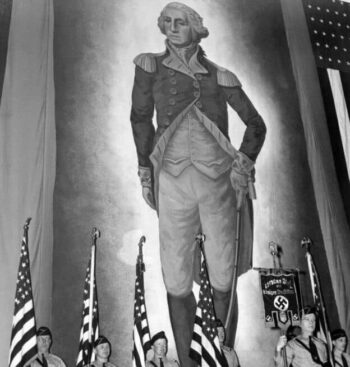
In this excerpt from John Bellamy Foster's
Trump in the White House (Monthly Review Press, 2017), Foster expands on the concept, origins, and practical effects of
Gleichschaltung (falling into line) in Nazi Germany and its relevance today. As Foster writes "to put such a neo-fascist strategy in place requires a new kind of
Gleichschaltung"; one in which all of society—from the judiciary to Congress to cultural and media institutions—are brought into line.