July 1, 2026
Since the wane of mercantilism in Europe, conceptions of wealth, trade, and productivity have also changed: from one of a zero-sum game reliant only on the productivity of land, to one of the potential for positive-sum wealth created by industry, and, now, to the zero-sum neomercantilism necessitated in a world of resource depletion, where the earth is pushed to its biophysical limits. But the response to this crisis does not have to be further fortification—it could also be a world that organizes itself within the metabolic limitations of nature.
July 1, 2026
In order to comprehend the environmental crisis that goes hand-in-hand with the "Structural Crisis of Capital," we must also understand the nature of global value chains and how they contribute to environmental degradation and worker exploitation on a global level. Benjamin Selwyn elucidates how global value chains and digitalization sit within a "conjoined dynamic of labor-exploitative accumulation and ecological expropriation."
July 1, 2026
Martin Hart-Landsberg gives an in-depth account of the oligarchs of Silicon Valley and their embrace of transhumanist ideologies that celebrate individualism and technological advancement above all else. However, he asserts, all is not lost, as growing dissatisfaction with capitalism "is slowly but steadily helping to grow a movement of resistance"—a resistance that must recognize that it is not just tech billionaires but capitalism itself threatening humanity's chance at a better future.
July 1, 2026
The world is being roiled by a crisis of meaning, leading to a pervasive sense of despair and stagnation. Helena Sheehan gives an account of the present-day epistemological nihilism resulting from the corrosion of "the foundations of knowledge production"—that is to say, the devaluing of rigorous scientific inquiry and the rise of irrationalism. Marxism provides us with both an understanding of how this crisis of cognition relates to the "Structural Crisis of Capitalism," as well as the socialist opposition that seeks to resolve its manifold contradictions.
June 1, 2026
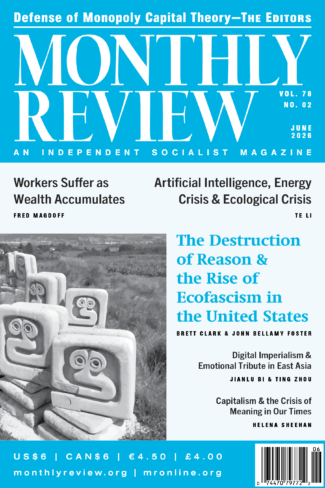
June's "Notes from the Editors" revisits the fundamental concept of monopoly capitalism as expounded by Paul A. Baran and Paul M. Sweezy in their pathbreaking
Monopoly Capital. The recent resurgence of the debate around Baran and Sweezy's work, the editors write, misses not only the enduring relevance of their analysis in an era of megacorporations and hyperscalers, but the revolutionary understanding of the economic system that arises from such an analysis.
June 1, 2026
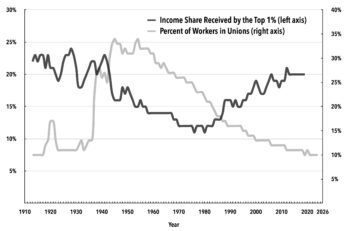
Fred Magdoff presents an incisive, data-driven analysis of the current state of the worker laboring under the domineering system of financialization and, in particular, private equity. In his conclusion, Magdoff asks: "Is there a way out of twenty-first-century 'normal' for labor?" "The key way out," he answers, "is an extraordinary growth of workers' power in order to combat the extraordinary power of capital"—one rooted in fully democratic socialist production and fundamental equality.
May 1, 2026
John Bellamy Foster takes on sweeping questions of artificial intelligence and its role in today's capitalist society. "The Great Houses of AI are divided against themselves and cannot stand," he writes, "If humanity is to flourish, the forces and relations of production must be revolutionized together…creating a world of sustainable human development."
May 1, 2026
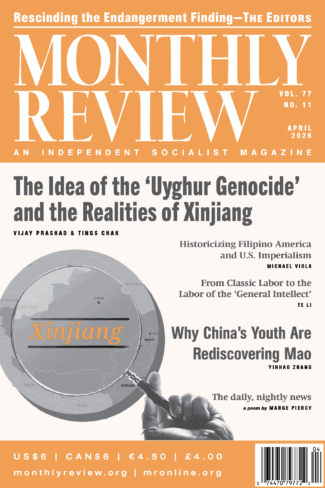
A new poem by Marge Piercy.
April 1, 2026
While the "world is rapidly approaching tipping points that spell irreversible and catastrophic climate change," write The Editors, "we are not seeing the necessary turn from ecological reform to ecological revolution, but rather the rise of ecological reaction.… An absolute no-quarters war from above is now being waged against all political attempts to address climate change." This attack is epitomized by "the Donald Trump administration's goal of removing the 2009 Endangerment Finding of the Clean Air Act that underlies all national climate legislation in the United States." While this tactic is unlikely to succeed, the proliferation of similar attacks clearly demonstrate that "[m]onopoly-finance capital has now abandoned the energy transition, which was its only answer to climate change."