July 1, 2026
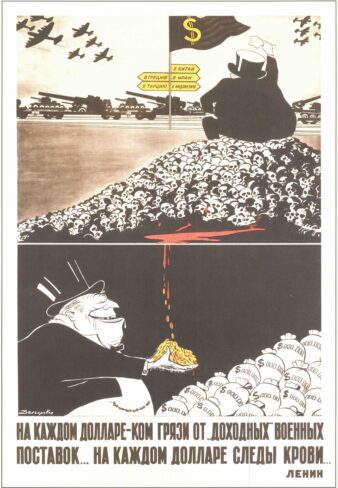
It is quite evident, Costas Lapavitsas begins, that the world is currently ensnared in geopolitical turmoil, perhaps for over a decade. In this article, Lapavitsas provides insight into the inseparable and interlocking mechanisms of dollar dominance and imperialism backed by the escalatory militarism of the second Trump administration. As Lapavitsas notes: "The dollar and the F-35—monetary coercion and military power—are two moments of a single structure of domination."
July 1, 2026
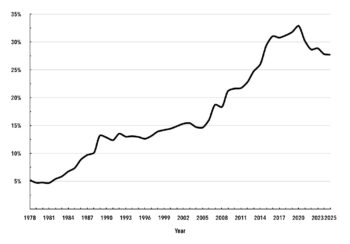
Over the last half-century, the "financial explosion"—manifest in the unrestrained expansion of financialization and its tools and institutions—has fundamentally reshaped the global economy, impacting countries throughout the Global North and South. China, however, has proven to be a distinctive case. Xiaolu Kuang, Zhi Li, and Fusheng Xie probe the question of how and why China has managed to maintain its emphasis on production above finance, and the development all above the accumulation of capital.
July 1, 2026
The world is being roiled by a crisis of meaning, leading to a pervasive sense of despair and stagnation. Helena Sheehan gives an account of the present-day epistemological nihilism resulting from the corrosion of "the foundations of knowledge production"—that is to say, the devaluing of rigorous scientific inquiry and the rise of irrationalism. Marxism provides us with both an understanding of how this crisis of cognition relates to the "Structural Crisis of Capitalism," as well as the socialist opposition that seeks to resolve its manifold contradictions.
June 1, 2026
MR associate editor Brett Clark and editor John Bellamy Foster explore "the death drive of late imperialism" and its manifestations in an ecological crisis that is not parallel to, but inseparable from, increasingly open ecofascism in the United States. Drawing from Luckács's
Destruction of Reason and István Mészáros's work on imperialism, Clark and Foster present a materialist analysis that illuminates the cult of unreason so pervasive under capitalism and imperialism while pointing to a path forward that is grounded in the historical-materialist Marxist tradition.
June 1, 2026
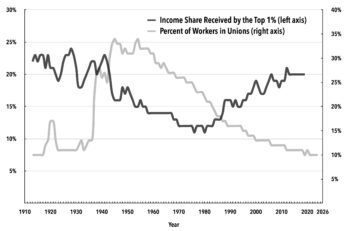
Fred Magdoff presents an incisive, data-driven analysis of the current state of the worker laboring under the domineering system of financialization and, in particular, private equity. In his conclusion, Magdoff asks: "Is there a way out of twenty-first-century 'normal' for labor?" "The key way out," he answers, "is an extraordinary growth of workers' power in order to combat the extraordinary power of capital"—one rooted in fully democratic socialist production and fundamental equality.
June 1, 2026
Philosopher and frequent
MR contributor Helena Sheehan considers the implications of living in a world in which a lack of meaning runs rampant, as well as how it is expressed in the literary world. If we lack coherent analysis, the varied crises of our times can seem disconnected and overpowering. A materially grounded Marxist worldview, she notes, allows us to clear away the fog of meaninglessness engulfing contemporary society and chart a path toward socialism.
May 1, 2026
This month's "Notes from the Editors" dissects recent attacks on historical materialism from so-called social materialism. This way of thinking, the editors write, is profoundly divorced from Marxism, in that it lacks a dialectical foundation and eliminates the ethical domain that is critical to building a revolutionary praxis.
May 1, 2026
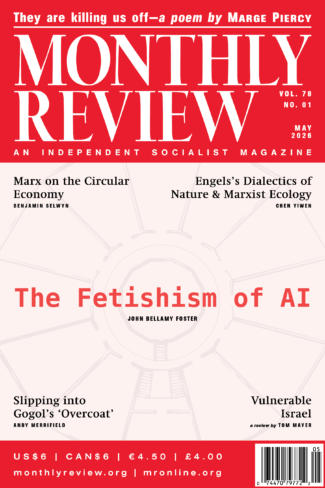
John Bellamy Foster takes on sweeping questions of artificial intelligence and its role in today's capitalist society. "The Great Houses of AI are divided against themselves and cannot stand," he writes, "If humanity is to flourish, the forces and relations of production must be revolutionized together…creating a world of sustainable human development."
May 1, 2026
Yiwen Chen dives deep into Frederick Engels's
Dialectics of Nature in order to give context to present-day debates surrounding the juxtaposition of the dialectics of nature and Marxist ecology. "It is hardly surprising that Engels's and Marx's ecological ideas are not entirely identical," Chen writes. "Nevertheless, their ideas do possess an inherent consistency."
May 1, 2026
Andy Merrifield reflects on Nikolai Gogol's short story "The Overcoat," tying it to "a distinctively Marxist problematic." In the protagonist of the tale, a Russian counsellor whose life is forever changed by the acquisition of a new overcoat, Merrifield finds a character who, like Marx, knows firsthand what a single coat can tell us about the structures of society.